What's in the case study:
A leading U.S. dairy company sells across yogurt, cheese, and cultured product categories on major online retailers. The category is fiercely competitive. Private-label brands dominate certain shelves, and national competitors invest heavily in paid search to capture visibility.
The Problem
The brand faced several interconnected gaps:
- No consistent way to track product rankings across search terms and retailers
- Organic and sponsored placements were not measured separately, making it impossible to tell where visibility was earned versus bought
- Competitor search strategies were a blind spot. The team knew the big players, but not where they were winning or how
- Retail media budgets were allocated without clear evidence of where the spend was working and where it was wasted
The Solution
The brand partnered with DataWeave, leveraging its Digital Shelf Analytics (DSA) platform to build a structured, always-on search intelligence program.
The DSA platform tracks 160+ search keywords across major U.S. retail platforms on a weekly basis, covering both generic category terms and branded keywords specified by the brand. For every keyword, the platform captures results from the brand's own portfolio, national competitor brands, and private-label products, giving the team a complete picture of who holds shelf visibility and how that breaks down across organic and sponsored placements.
Unlike retailer-specific tools that only show performance within a single platform, the DSA dashboard provides a unified cross-retailer view, so the team can spot patterns and inconsistencies that would be invisible when looking at one retailer at a time. Two core modules drive the program:
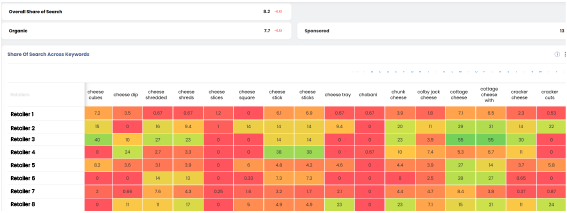
- Share of Search measures the brand's visibility for keywords at major retailers, broken down by organic share, sponsored share, and overall share. This three-layer split reveals whether visibility is earned through content relevance or dependent on ad spend.
- Share of Category tracks the brand's presence across retailer category navigation paths, benchmarking performance against competitors and surfacing assortment gaps.
Together, these modules cover the two primary ways shoppers discover products online: searching and browsing. The weekly cadence meant the team caught changes in days, not months.
The Impact
A Framework for Keyword Prioritization
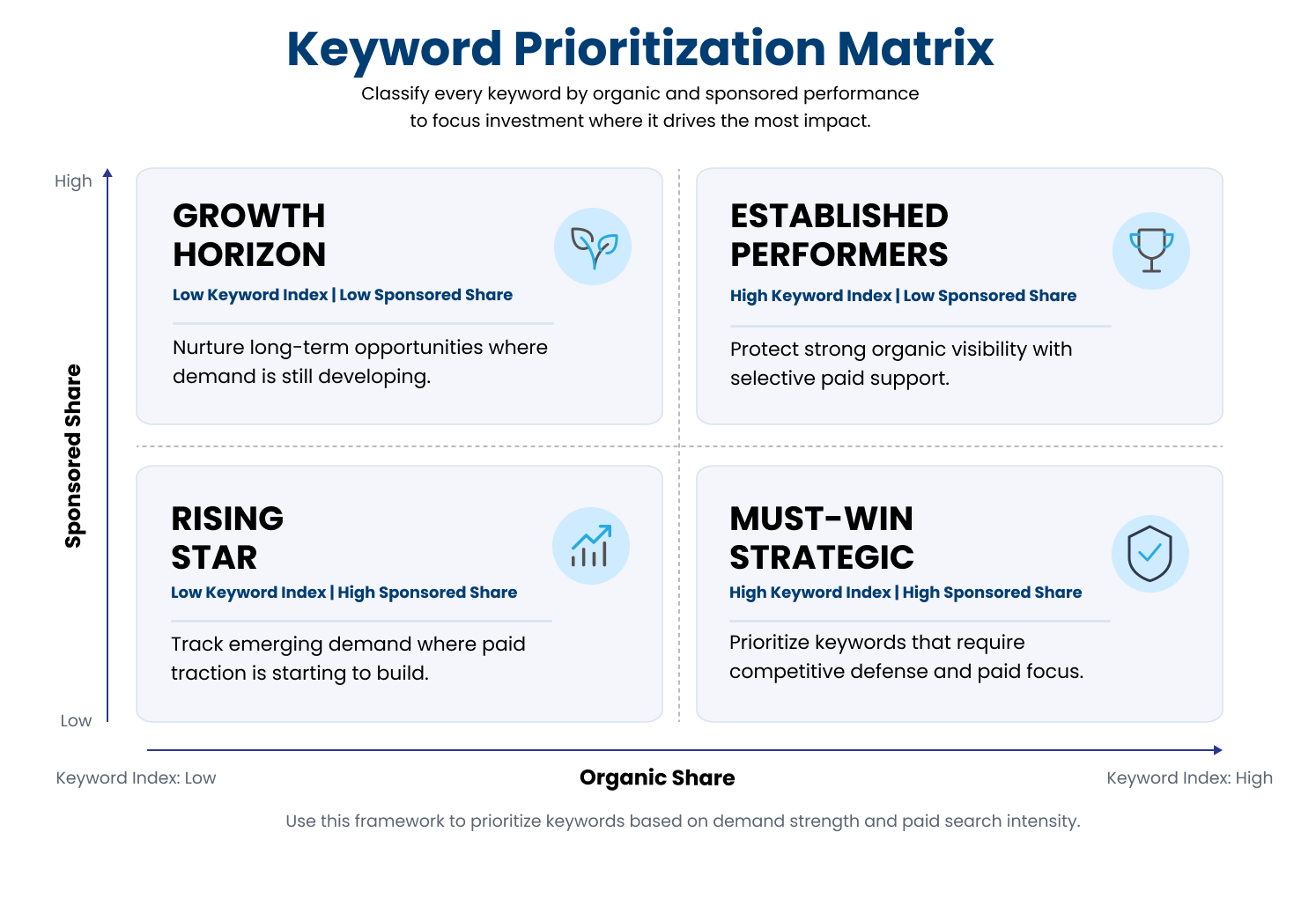
For each keyword, the platform compares the brand's organic and sponsored share on that term against its averages across all keywords. The intersection places every keyword into one of four groups.
Before this program, the brand had no structured way to decide which keywords deserved more investment and which were already performing well enough on their own. Every keyword was treated with roughly equal priority. The DSA platform changed that by introducing a four-quadrant keyword classification, built on organic and sponsored index scores, that sorts every tracked keyword into a clear strategic bucket.
The classification updates with every weekly data refresh, giving the team:
- Clear direction on which keywords to protect, which to push, and where to reallocate spend
- Early detection of competitive positioning shifts, visible within days rather than at the next quarterly review
- The ability to view the shelf from any competitor's perspective. Selecting a rival brand recalculates every score as if the team were managing that brand's search strategy, revealing how competitors allocate between organic and sponsored investment across specific keywords
Smarter Allocation of Retail Media Spend
The organic and sponsored split at the keyword level surfaced a pattern the team had suspected but could never quantify:
- On several high-value keywords, the brand's products were ranking well organically and appearing in sponsored placements at the same time
- The brand was effectively bidding for clicks on listings that shoppers were already finding without paid help
- The spend was not driving incremental visibility. It was duplicating visibility the brand had already earned
With these overlaps now visible, the team could better allocate spend based on evidence rather than assumption. Data-informed decisions replaced guesswork: defend the keywords that mattered most, step back where organic strength was sufficient, and redirect investment toward growth-horizon terms where the brand had low share and competitors were actively building presence.
Retailer-Specific Search Strategies
Search results are structured differently on every retailer, and those differences change the math on paid search entirely:
- One major retailer showed up to ten sponsored placements before any organic result appeared. This meant that a shopper searching for yogurt on that platform may scroll past ten paid listings before seeing a single organic result
- Another retailer capped sponsored slots at three or four, giving organic rankings significantly more weight
- Private-label dominance varies sharply. At one retailer, store brands captured close to half of page-one results across key dairy keywords
These structural differences made it clear that a single national search strategy would always overspend in some places and underinvest in others. With retailer-level data, the team now sets bids, keyword priorities, and spend thresholds separately for each platform, matched to how that retailer's search environment actually works.
Category Intelligence and Distribution Gaps
Share of Category tracking uncovered products that were technically in stock but missing from the correct category navigation shelves. In one case, a priority SKU appeared at three of four tracked locations for a retailer but was entirely absent from the fourth. It was not an out-of-stock issue. The product simply did not appear when a shopper browsed the relevant category, a gap that availability monitoring alone would never catch.
The category view also surfaced competitive assortment shifts that search tracking alone would miss. In several instances, competing brands began appearing in subcategories where they previously had no presence, giving the team an early signal to reassess keyword strategy and assortment priorities before a competitor could establish a foothold.
Share of search tells you who is showing up. Category intelligence tells you why.
When a competitor holds strong search visibility for a keyword group, understanding how many relevant products they have in that space adds critical context. If a competing brand has five string cheese products and all five are ranking organically on page one, that signals a brand with deep assortment strength, not just good ad spend.
The team uses this lens to identify where competitors are structurally well-positioned, where their own assortment may need to expand, and where there are openings to gain ground at specific retailers.
From Search Spend to Search Strategy
The shift wasn't about collecting more data. It was about structuring the data the brand already needed into a framework that drives weekly action. DataWeave's platform gave the team that framework: a single cross-retailer view of search and category performance, updated weekly, broken down by organic and sponsored placement, and benchmarked against every relevant competitor.
In a category where private-label pressure is constant and ad budgets are finite, the brands that win shelf visibility are the ones that know exactly where to compete and where to conserve. That's the difference between spending on search and investing in it.



Login
For accounts configured with Google ID, use Google login on top.
For accounts using SSO Services, use the button marked "Single Sign-on".