
The Accountability Gap: Why Explainable AI Decides What Scales in Enterprise Commerce
17th Aug, 2026

By Namrata
Enterprises have run on one discipline for decades. Every consequential decision arrives with a rationale someone can inspect and defend. A price change has an approval trail. A budget has assumptions attached. When a number breaks, someone can walk back through the reasoning and find where it went wrong.
AI strains that discipline at exactly the moment it becomes most useful. An enterprise retailer now makes thousands of decisions a day that AI either takes outright or shapes heavily. A matching engine pairs products against a dozen competitors and sets the benchmark for a price. A content system scores product pages and clears new copy to go live. The people who answer for those outcomes increasingly sign off on results without ever seeing the reasoning that produced them.
That space between what a system does and what its owners can explain is the real barrier to scaling AI in commerce. Call it the accountability gap. It measures the distance between a model that is accurate and a model a business can stand behind.
Why explainability decides what scales
The adoption numbers tell a consistent story. McKinsey’s 2025 State of AI survey found that 88% of organizations now use AI in at least one function, yet only about a third have carried a program past the pilot stage. MIT’s State of AI in Business 2025 put the sharpest number on it: 95% of enterprise generative AI pilots delivered no measurable impact on the P&L. MIT’s researchers pointed mostly at workflow integration and a learning gap, and they are right that model quality is rarely the culprit.
But ask leaders directly why deployments stall and a more specific answer surfaces. They will not vouch for outputs they cannot explain. Grant Thornton’s 2026 AI Impact Survey of 950 senior leaders found that 78% lack strong confidence they could pass an independent AI governance audit within 90 days. In a separate survey, nearly six in ten leaders said they had delayed, paused, or canceled an AI deployment over trust concerns. Nobody scales a decision they cannot explain.
The pressure is compounding because the human buffer is disappearing. For most of the last decade, AI in commerce was an advisor. It flagged a price gap or scored a piece of content, and a person applied judgment before anything reached a customer. The human was the accountability layer. That arrangement is ending. McKinsey found 62% of organizations already experimenting with AI agents and 23% scaling them in at least one function. Once systems set prices, adjust assortments, and confirm matches with little human review, the question a leader must answer changes shape. It is no longer whether they agree with a recommendation. It is whether they can reconstruct why something happened, weeks later, when a downstream number breaks.
Regulators are converging on the same expectation. The EU AI Act requires consequential systems to be transparent enough for a deployer to interpret their output, with oversight and logging built in, and US states keep redrawing their rules around automated decision-making. The specifics shift, but the direction holds. Whether the audience is a regulator, a customer, or your own board, you need to be able to explain what the system did.
Why this matters for enterprise retail
Commerce concentrates the problem because its decision chain together at speed and each link inherits the errors of the one before it.
A pricing decision is only as sound as the product match beneath it. Before you act on a rival’s price, you have to know you are comparing the same product, or a substitute you chose deliberately. Get the match wrong and the chain inverts. A bad match feeds a bad benchmark. A bad benchmark feeds a bad price. A bad price bleeds margin or hands you a false read of the market, which sends the next decision wrong too.
There are several ways for a mismatch to happen. For instance, two listings can share a title and diverge on brand. A Beringer Bros. bourbon-barrel Cabernet set against a different producer’s bourbon-barrel Cabernet, same varietal, same aging, same 750ml bottle. The one thing that separates them is the brand: they are different wines from different producers, a fact that lives in brand knowledge rather than in the words a model parses most confidently. Match them as one product and your Cabernet gets benchmarked against a rival’s, priced on a different tier as if it were your own. That is one scenario. A mismatch can happen for several other reasons too:
- Two listings can match on everything but pack count, a 12-pack benchmarked against a 6-pack.
- They can split on a variant buried in the descriptor, like regular coffee pods read as decaf, or a tub of plant butter matched against sticks.
- Or they can turn on an attribute that appears in neither title: a wild-caught line versus a standard one, or a wine vintage the listing never states.
Each of these is a real pairing a naive match treats as one product. In all these scenarios, the difference lives somewhere a model reading the title confidently will miss: in brand knowledge, in pack math, in a variant field, or in an attribute nobody wrote down. This is why “just use a better model” doesn’t answer the problem. There is no single parsing fix that catches every type of mismatch, because they don’t break for the same reason.
Because no reasoning is attached to the match, nobody sees the error when it happens. It resurfaces days later as a margin anomaly, and the team does the only thing it can: work backward by hand through spreadsheets and root-cause meetings, reverse-engineering a decision the system never explained. The work did not vanish when AI got faster. It moved downstream, grew more expensive, and eroded trust along the way.
Content decisions carry the same structure with a wider blast radius. A single flawed content rule, applied automatically, can rewrite thousands of product pages before anyone reviews it. And the stakes on those pages have risen, because the product page is now read by machines as much as people. AI assistants deciding whether to surface your product at all are parsing the same titles, attributes, and descriptions your content system just changed. An unexplained content decision is no longer a cosmetic risk. It is a discoverability risk.
What explainability actually requires
Explainability gets dismissed as either impossible or academic, usually by people who picture it as exposing a model’s inner weights. A commerce team needs nothing that exotic. What makes AI deployable lives at the decision layer, not inside the model, and it comes down to three things every decision should carry with it.
- Evidence: Show what drove the output. For a product match, that means surfacing the attributes that made two listings the same product. For a content recommendation, it means stating what is missing or underperforming and why the change matters. A reviewer should see the basis for the decision rather than take it on faith.
- Confidence: Signal how sure the system is. A plain high, medium, or low rating changes how a team spends its hours. People stop checking everything or nothing and start looking hardest where the system itself is least certain.
- Auditability: Keep a trail you can reconstruct. The point is to put scrutiny in front of the action instead of after it breaks. When last week’s price moves get questioned, the answer should be a specific decision a team can open and inspect, not a ticket and a two-week investigation.
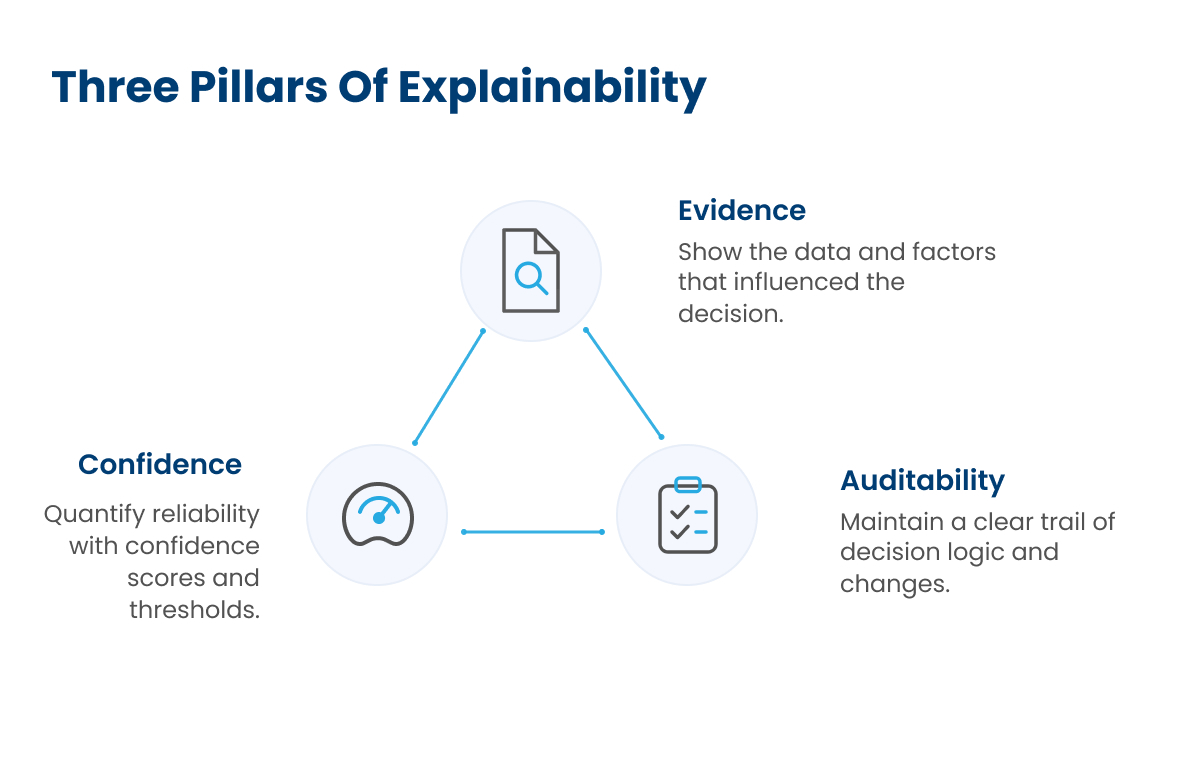
Together these define a standard worth naming: explained accuracy. Not just the right answer, but the right answer with its working attached. Accuracy alone does not get an AI system adopted. Adoption comes when a team can see why the system is accurate and put their name on it.
How DataWeave builds explanation into its recommendations
DataWeave treats these three requirements as product mechanics rather than talking points, across the two decision types where the accountability gap costs retailers most: product matching and PDP content.
Product matches you can open and inspect
The matching engine reads a product across every signal available, breaking messy titles into brand, attributes, pack size, variant, and net content, and comparing images against a library of more than 100 million indexed photos. What makes this explainable is what a reviewer sees when they open a match: the two SKUs side by side, the extracted attributes that agreed, the ones that did not, and the image comparison that supported the pairing. Each of the failures above surfaces in the field where it actually lives.
The brand mismatch shows up as a brand field that disagrees, not a hidden assumption. The pack-count gap sits in a normalized size attribute. The buried variant lands in a variant field a reviewer reads in seconds. The attribute stated in neither title is exactly where the image comparison earns its place. A reviewer doesn’t need to know in advance which of the four they’re looking at, the view shows them which attribute broke, so they can reject the pairing before the benchmark ever reaches a price.
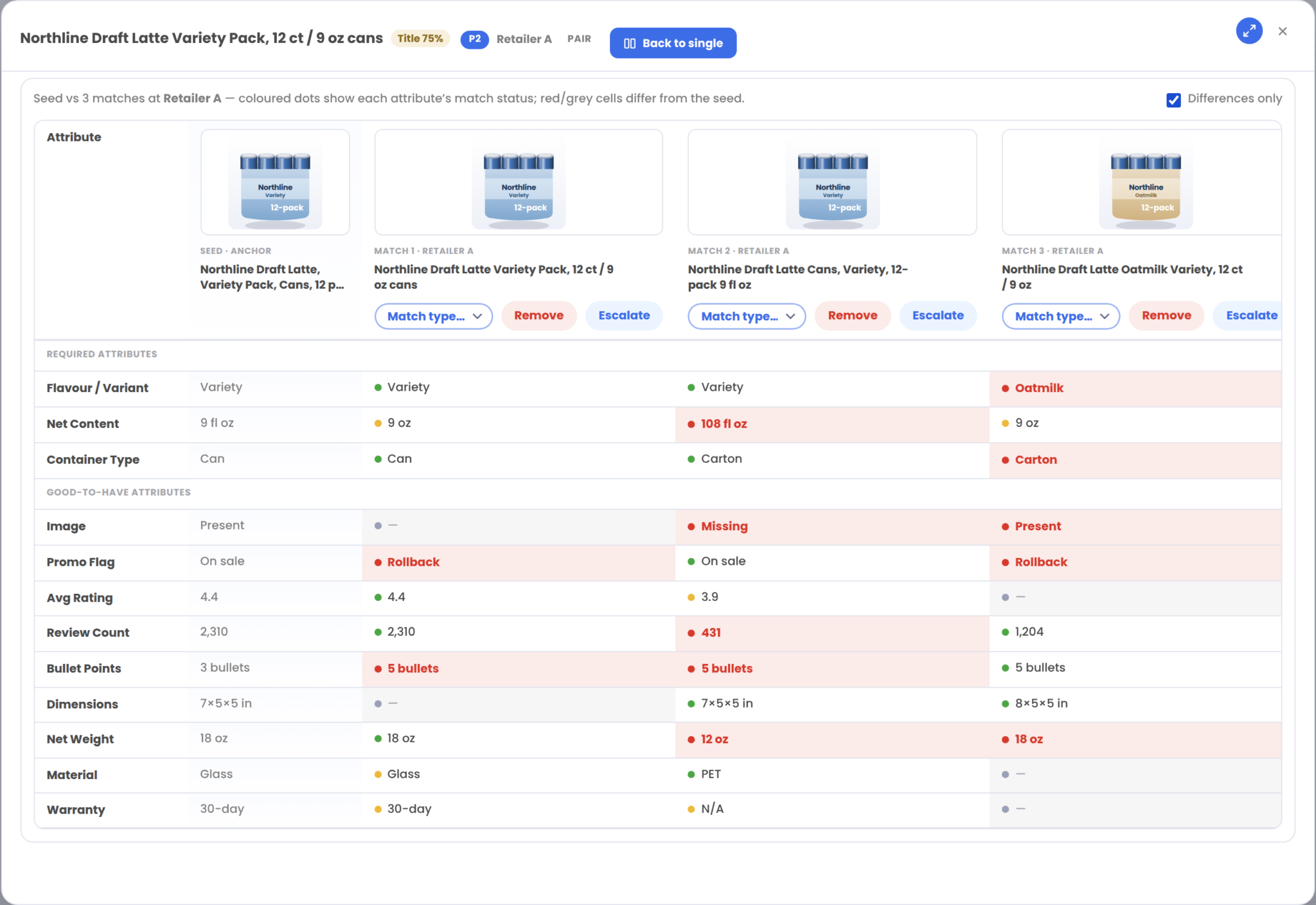
Confidence then decides where human attention goes. High-certainty matches clear automatically. The ambiguous cases, the ones a model should not rule on alone, route to specialist reviewers through Veracite, our human-in-the-loop layer, so scarce review capacity lands on the decisions that actually need a person.
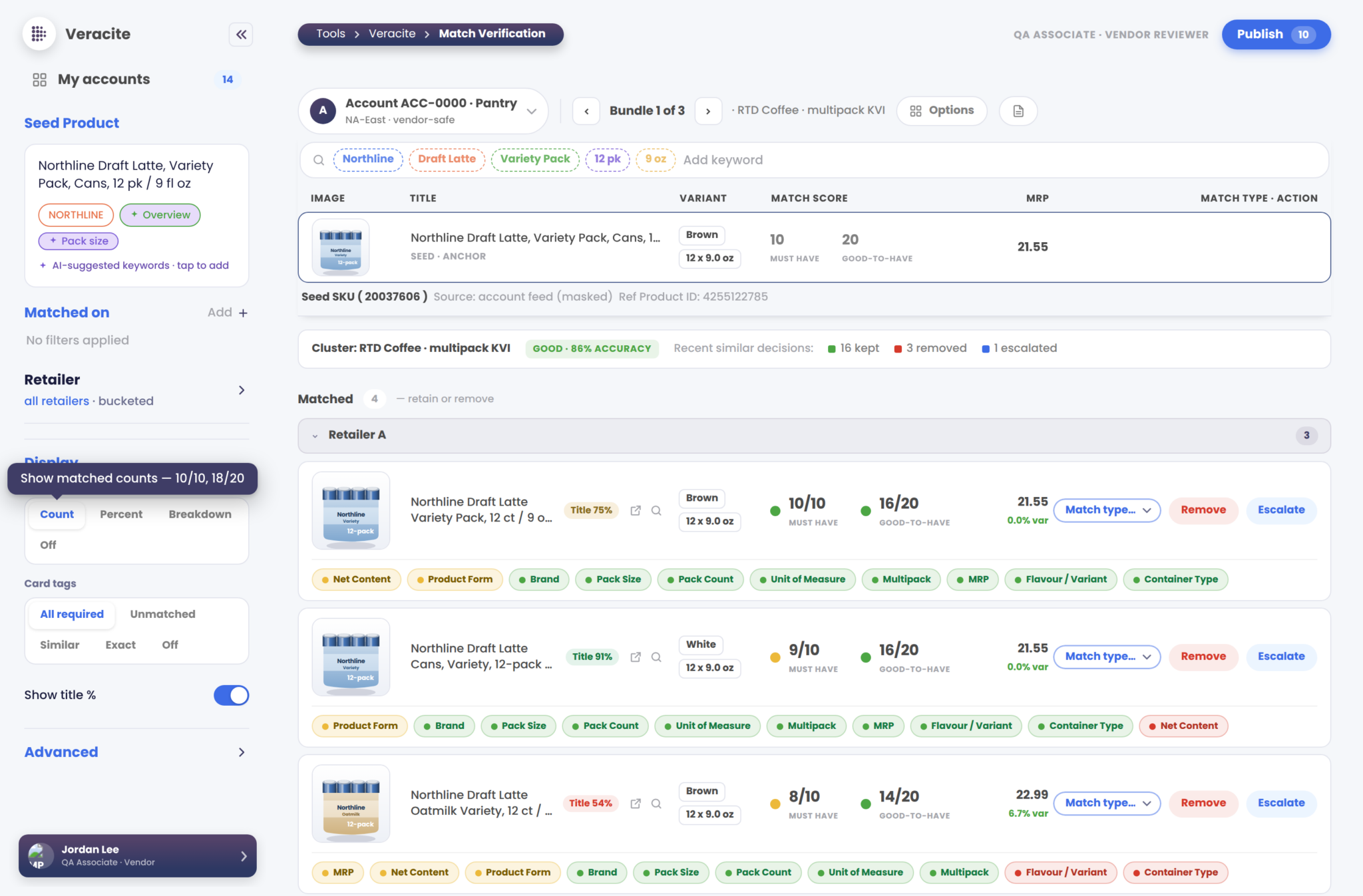
The accuracy figures hold up, at 99%+ match accuracy even on incomplete source data. But the point is that you do not have to take that number on faith. Output ships with visibility into match rates and miss rates, and every reviewed case becomes a new training example in a base of more than 40 million verified product pairs. The system’s track record is itself auditable.
Content recommendations that show their reasons
The same discipline applies to the digital shelf. DataWeave’s content optimization solution compares your products against competitor SKUs. It reads both down to the attribute level and highlights what your PDP or listing is missing: absent specifications, details competitors carry that you do not. From there it helps retailers close those gaps, recommending the missing attributes to add and rewriting existing titles and descriptions to match what the category leaders publish.
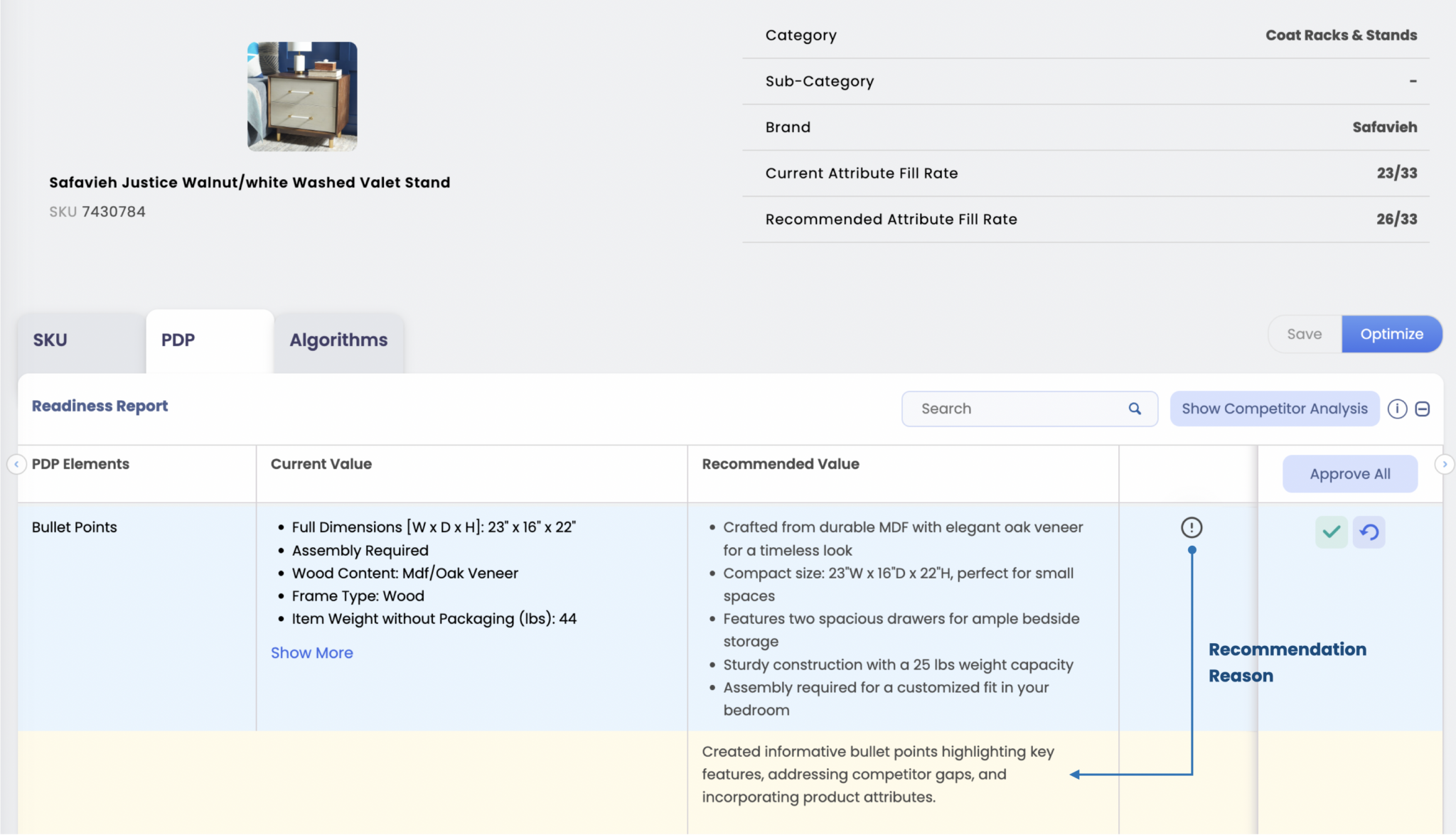
Every recommendation comes with its reason. DataWeave’s content optimization dashboard tells you which competitor SKU exposed the gap, what is missing, and why closing it matters for how the page gets found. The reviewer stays in control: accept, reject, or edit each suggestion before anything ships.
That explanation is what makes the recommendation safe to act on at scale. A content team can challenge a suggestion before it rolls out across a thousand SKUs, accept it knowing exactly what it changes, and answer for the result afterward. As AI assistants become the first reader of every product page, knowing precisely why your content changed matters as much as the change itself. It is the same foundation DataWeave uses to give AI agents a consistent, comparable, and explainable view of the shelf.
Demand explained accuracy
The first wave of commerce AI competed on raw capability: bigger models, faster output. That race no longer decides who wins, because if a business cannot explain its capability, it cannot use it at scale. What separates deployable AI now is whether a team can trace, verify, and defend what it produced, whether the audience is a CFO questioning a margin swing, a regulator asking how a price was set, or a board asking why the pilot deserves a bigger budget.
The standard to hold your vendors to is explained accuracy. Every match, every score, every recommendation, delivered with the evidence, confidence, and audit trail that lets your team put their name on it.
See how explainable decisions change what your pricing and content teams can actually put into production. Talk to DataWeave.




Login
For accounts configured with Google ID, use Google login on top.
For accounts using SSO Services, use the button marked "Single Sign-on".