In the Image: Without a governed system, the same product shows different content in every channel; with DataWeave, one enriched record stays consistent everywhere it's published.

For two decades, product content optimization was a search problem. Optimize the title, fill in the attributes, refresh the description on a cadence. The catalog won when shoppers found it through keyword search and clicked through.
That game is over. The systems that increasingly mediate product discovery do not match keywords. They read content, score it, and decide. Amazon's Alexa for Shopping and Walmart's Sparky now sit between brands and shoppers inside the marketplaces that drive the majority of online purchases, with Alexa for Shopping alone reaching 300 million users in 2025. ChatGPT, Perplexity, and Google AI Mode have turned AI referrals into one of the fastest-growing retail traffic sources, with conversion rates that now beat traditional channels. AI Overviews shape the consideration set on 83% of "best [product]" queries.
The catalogs winning on these surfaces share a common discipline. Their content is complete. Their attributes are dense and category-appropriate. Their data is consistent across every retailer endpoint, marketplace listing, and product feed. Their visibility is measured continuously, not audited quarterly. And critically, they have figured out how to operate this discipline across catalogs too large to manage by hand: thousands of SKUs across dozens of retailers for brands, millions of SKUs across thousands of categories for retailers and marketplaces.
This whitepaper lays out the new rules, why traditional workflows cannot meet them, and how DataWeave's seven-stage flywheel, governed AI architecture, and maturity model give retailers and brands a clear path from reactive content fixes to a continuous, compounding operational advantage.
The digital shelf has always been more than a product detail page. But the shape of discovery itself is now bifurcating. Brands need to surface inside AI assistants they do not control. Retailers need to draw shoppers to their site through an external AI layer that increasingly mediates the open web. Both pressures lead to the same content discipline, but the urgency comes from different places. And the scale of the shift means content gaps that were once an annoyance are now a structural drag on revenue.
The most consequential AI shift for brands is happening inside the marketplaces. Amazon's Alexa for Shopping (previously called Rufus) reached over 300 million users in 2025, and is credited with roughly $12 billion in incremental annualized sales. Shoppers using Alexa for Shopping are 60% more likely to convert. Walmart's Sparky, launched in June 2025, was in the hands of roughly half of Walmart app users within months. For a brand selling across Amazon and Walmart, that is hundreds of millions of shopping interactions per year now mediated by an AI assistant.
These assistants do not just rank products. They decide. When a shopper asks Alexa for Shopping for "a quiet humidifier for a nursery under $80," the assistant does not return fifty filtered results. It surfaces a small recommendation set, often a single product, and frames its choice with reasoning. The product that wins is the one whose content most clearly satisfies the criteria. Vague titles, missing attributes, and inconsistent descriptions are filtered out before they get to compete.
At the scale these surfaces now operate, the math is unforgiving. A brand with 900 SKUs and a 30% attribute completeness gap is not losing a handful of recommendations a day. It is losing hundreds. Every missing specification compounds across every shopper query the system ever processes.
The same dynamic plays out on external AI surfaces. ChatGPT, Perplexity, and Google AI Mode now research and compare products before the shopper ever lands on a retailer site. Among U.S. shoppers who have adopted AI tools, 85% use them at least weekly, per a SEMrush study of 1,030 consumers in late 2025. The brands that get cited in this layer enter the shortlist. The ones that do not, do not.
And the gap that determines who gets cited is rarely the content a brand wrote. It is the content shoppers and AI systems actually see after syndication. When a brand syndicates content to fifty retailers, each retailer renders it differently. Titles get truncated. Descriptions get rewritten. Attributes get dropped. The structured data says one price, the rendered page says another, the Merchant Center feed shows a third, the Amazon listing carries different bullets and a different title. AI systems cross-check across endpoints and treat mismatches as untrusted, filtering out the product before it gets to compete.
Most brands have no visibility into this drift. DataWeave is uniquely positioned to close the gap. The platform monitors content across 1,500+ retailers and marketplace endpoints continuously, comparing the version a brand syndicates against the version each retailer actually renders. Early data shows a significant share of branded SKUs displaying measurable drift between the syndicated and live versions, ranging from altered titles and missing attributes to reformatted descriptions. That drift compounds silently across every AI surface that reads the content.
For retailers, the harder problem is external: how to draw shoppers to their site through an AI layer that increasingly mediates the open web. The scale here moved fast. Adobe data showed traffic to U.S. retail sites from generative AI sources up roughly 4,700% year over year in mid-2025, with a 693.4% spike during the 2025 holiday season.
AI-referred shoppers were converting 38% below existing traditional channels in March 2025. But by March 2026, they were converting 42% above, per Adobe. The gap didn't just close. It flipped and kept widening. What was a rounding error two years ago is now a meaningful share of high-intent traffic.
The mechanics reward different content than classical SEO. Google AI Overviews now appear on roughly 14% of shopping queries overall, but Google has deliberately split the surface by intent. Transactional queries like "buy" and specific product names rarely trigger an AI Overview. Informational ones do; "best [product]" queries now trigger an AI Overview 83% of the time, up from 5% a year earlier. AI Overviews shape consideration sets during research, where shoppers are still deciding what to buy. The retailer cited in that window earns a path to their site. The retailer that is not is invisible at the moment the shortlist is being built.
External AI assistants compound the effect. ChatGPT and Perplexity routinely cite retailer pages, but the logic favors content that is dense, structured, and accessible to AI crawlers. For a retailer running a six-figure or seven-figure SKU catalog, the visibility problem is no longer about getting a hundred hero pages right. It is about whether the long tail, the category no merchandiser has touched in eighteen months, is in good enough shape to be cited at all.
Whether AI is reading content from inside a marketplace or from across the open web, the system rewards the same things. Complete attributes. Structured data. Content density. Consistency across every surface the product appears on. A vague title hurts a brand in Alexa for Shopping and hurts a retailer in an AI Overview. A missing specification keeps a brand out of Sparky's recommendation and keeps a retailer out of a Perplexity citation.
At catalog scale, none of this can be solved by hand. Brands have hundreds of SKUs across dozens of retailers. Retailers have millions of SKUs across thousands of categories and an ever-shifting layer of third-party sellers. The content discipline that wins on AI surfaces is the same content discipline that has always mattered, but it now needs to operate continuously across the entire catalog, not just the SKUs that get attention because something broke.
The brand problem and the retailer problem look different. The content discipline that solves them is the same.
The shift toward AI-mediated discovery is changing more than how shoppers find products. It is changing how product pages are read in the first place. AI systems retrieve chunks, ration tokens, and increasingly reject content that is expensive to extract. Six specific levers separate the PDPs that win citation share from the ones AI agents quietly skip: crawler access, render-time density, structured data, real-time offer schema, earned media, and parity across surfaces. Get each one wrong, and your products disappear from the answer. See how to get them right in this article.
Most enterprise content workflows were designed for a simpler environment: smaller catalogs, more stable platform requirements, and a discovery landscape dominated by keyword-based search. The cracks in that model are now structural failures, not edge cases.
Content lives everywhere, and nowhere. Product content is scattered across PIMs, spreadsheets, retailer portals, CMS platforms, and syndication tools. When a content gap is identified, the first question, where is the authoritative version, is itself a problem. Updates happen in one place and fail to propagate. Corrections made in a PIM do not reach retailer portals. Retailer modifications are never flagged back to the brand. Content debt accumulates silently across channels.
Updates are reactive, not systematic. The most common content trigger in most organizations is still a customer complaint, a listing rejection, or a quarterly reminder to refresh. By the time a problem surfaces through one of these signals, it has often been eroding performance for weeks or months.
Data quality has no consistent definition. Without shared scoring rules, good content means different things to different teams. A title that satisfies the brand manager may fail the retailer's character limit. A description that reads well to a copywriter may omit the five attributes an algorithm needs to rank the product correctly. When quality is subjective, it cannot be managed at scale.
Content parity across surfaces is now a trust signal. As mentioned in the previous chapter, AI systems cross-check content across endpoints and treat mismatches as untrusted. Brands that cannot measure the gap between what they syndicate and what retailers actually render are accumulating content debt they cannot see. Without continuous monitoring across retailer endpoints, parity problems compound silently.
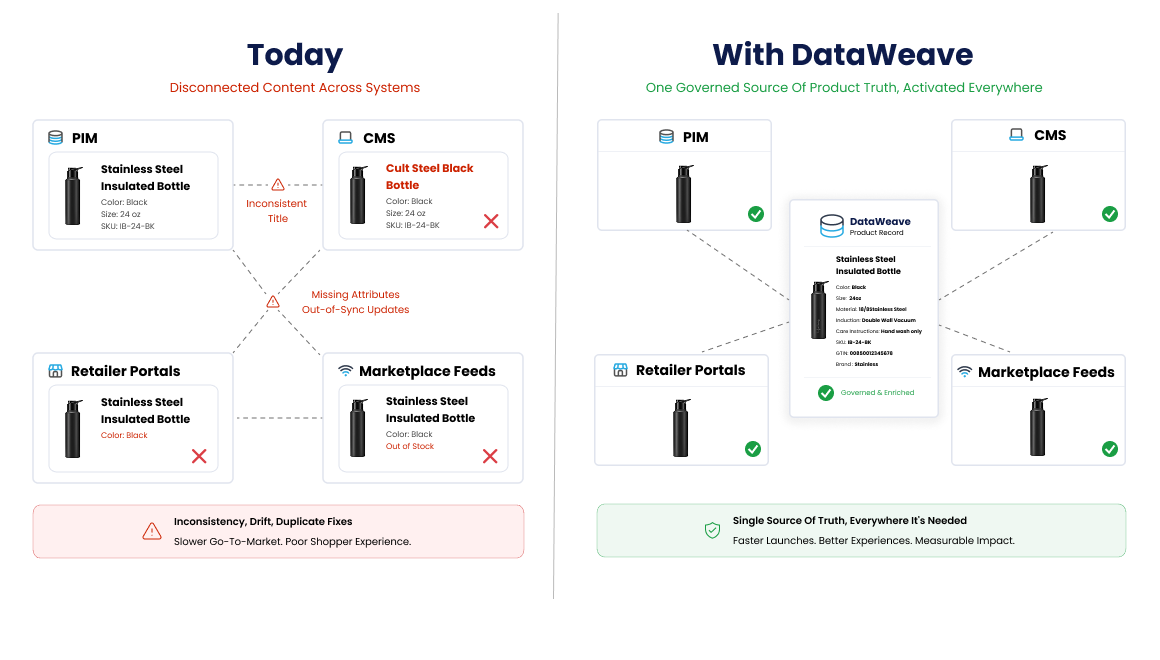
The strategic reframe. Content is no longer a marketing asset alone. It is operational infrastructure that directly affects discoverability, listing eligibility, conversion rates, and return rates. It belongs in the same governance category as pricing data or inventory accuracy, and it requires a system designed for that level of operational rigor.
DataWeave's Content Optimization Solution is built specifically for this shift: a governed, continuous, AI-powered operating system for product content, designed to work at digital shelf scale across retailers, marketplaces, and brand-owned channels.
Modern content excellence cannot be achieved through periodic projects. It requires a closed-loop operating model that runs continuously, learns from performance data, and adapts to changing conditions. DataWeave's seven-stage flywheel is that model.
Each stage builds on the output of the previous one, and the loop never closes. It accelerates as performance data improves the quality of every subsequent cycle. What makes this flywheel different from a generic content workflow is what powers it: live retail data from 500+ retail and marketplace endpoints, category-specific intelligence tuned by vertical, and governed AI that operates within enterprise-safe guardrails.
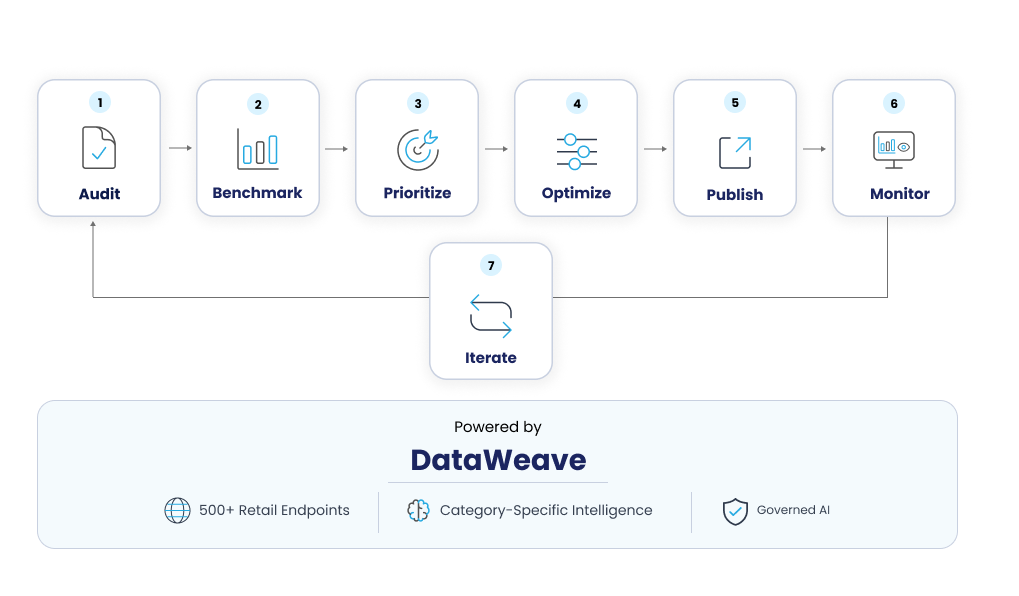
The flywheel begins with visibility. DataWeave's automated rule-based scoring evaluates every SKU across titles, images, descriptions, bullets, and attributes. Scoring applies retailer-specific compliance rules, category-specific completeness requirements, and brand integrity checks simultaneously. The audit also flags AI-readiness gaps: crawler accessibility, content density in rendered HTML, and whether critical specs sit behind JavaScript or accordion patterns that AI retrieval pipelines cannot reliably reach.
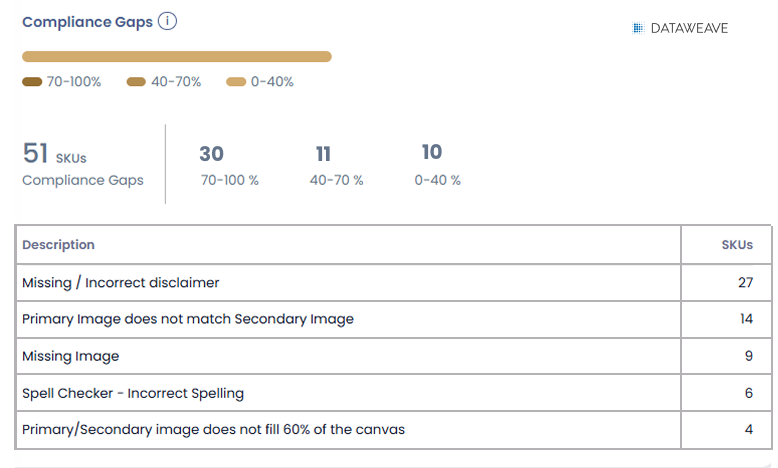
Content health scoring uses a 0 to 100 scale applied consistently across the catalog. SKUs scoring 0 to 40 need immediate optimization before they damage discoverability. SKUs scoring 41 to 70 are functional but vulnerable to better-optimized competitors. SKUs scoring 71 to 100 are well-optimized and need monitoring rather than rework. Because scoring rules are tuned by category and vertical (grocery, electronics, CPG, apparel, home improvement, and more), the system reflects the reality that a drill's required attributes differ fundamentally from a dress's.
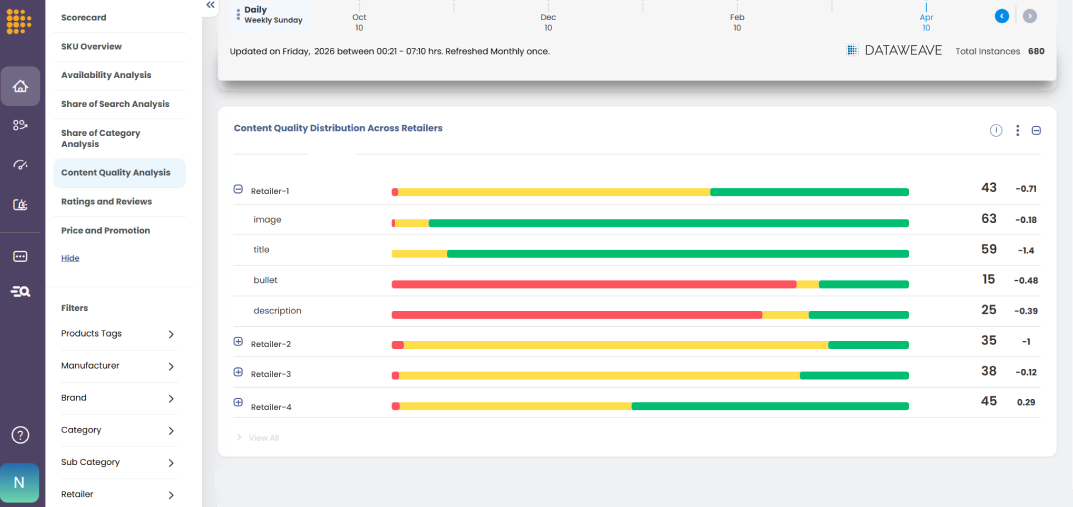
A content score in isolation is incomplete. A product scoring 72 may be leading the category or trailing it significantly, depending on what competitors are doing. The benchmark stage matches each product to competitor listings selling identical or similar items and quantifies the gap in specific terms. Not "your content is below average," but "your top three competitors include battery charge time, cord length, and noise level in the title. You include one of the three." Because DataWeave operates on continuously evolving live retail data rather than static catalogs, benchmarks reflect what is actually ranking and converting right now.
Not all content gaps carry the same business weight. The prioritization stage ranks issues by business impact, including traffic, revenue, and margin, and weights them by severity, distinguishing compliance violations from formatting inconsistencies. Tasks route to the appropriate teams. The highest-ROI fixes surface first.
With priorities set, DataWeave's AI optimization engine generates improved content grounded in competitive context and constrained by governance rules: optimized titles built from category-specific templates, descriptions rewritten for clarity and AI-search relevance, attribute extraction from unstructured text or product images, platform-specific content variations for Amazon vs. Walmart, and compliant alt text for all images. AI output here is not unconstrained generation. It operates within the rules established in the audit and benchmark stages.
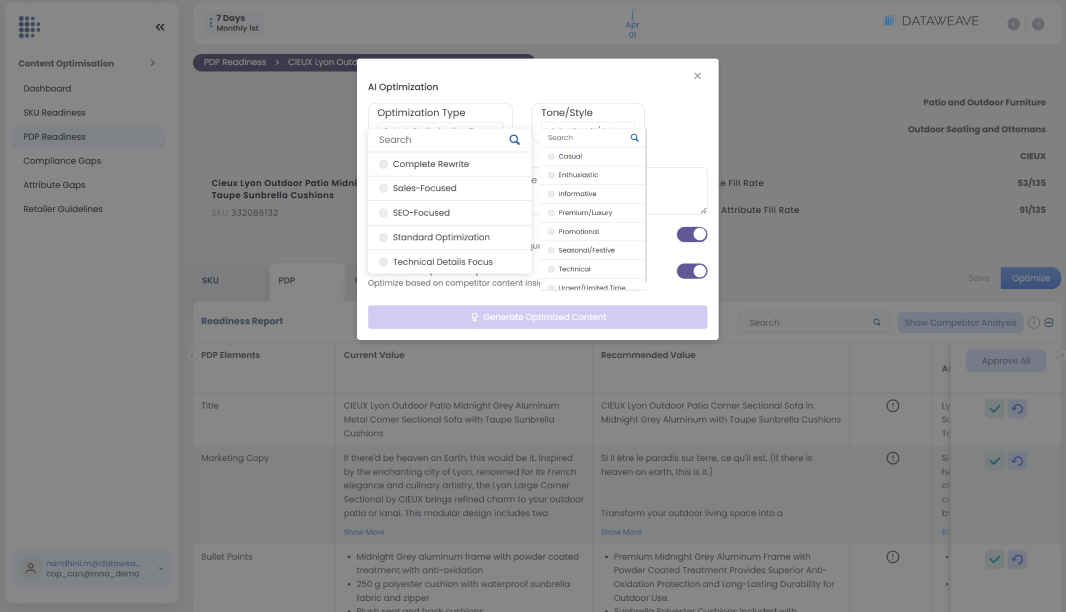
To illustrate: a 65-inch frameless wall mirror might need a title rewritten to include the three attributes competitors universally list, a description expanded to answer the questions AI shopping assistants typically extract, and attribute fields completed to satisfy Walmart's compliance schema, all while maintaining the brand's voice guidelines. The flywheel handles all three in a single cycle, scored against the same rubric.
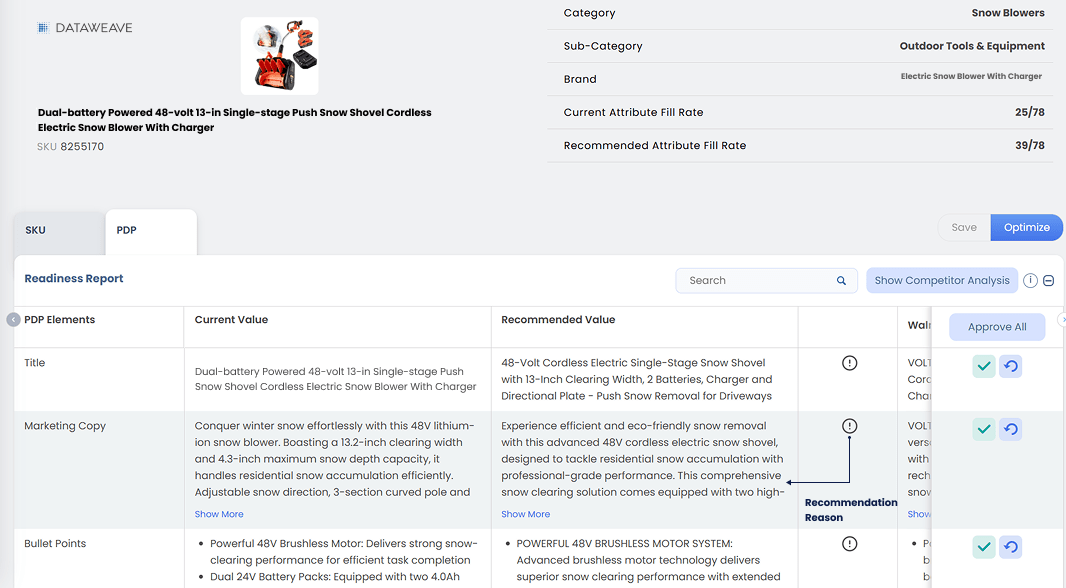
Optimized content enters an approval workflow before going live. DataWeave integrates with PIMs, CMSs, syndication feeds, and marketplace APIs, working within existing infrastructure rather than requiring organizations to rebuild workflows. Beyond publishing, the platform monitors content parity across surfaces. When the description on Walmart drifts from Amazon, when a retailer modifies a syndicated title, or when structured data falls out of alignment with rendered content, the system flags it. Full audit trails support compliance requirements; rollback controls ensure problematic updates can be reversed without manual reconstruction.
The monitor stage connects content changes to business outcomes. CTR, conversion rates, search rankings, and content health scores are tracked at SKU and category level. The system identifies which optimization patterns consistently drive results and flags when competitor content changes threaten current positioning.
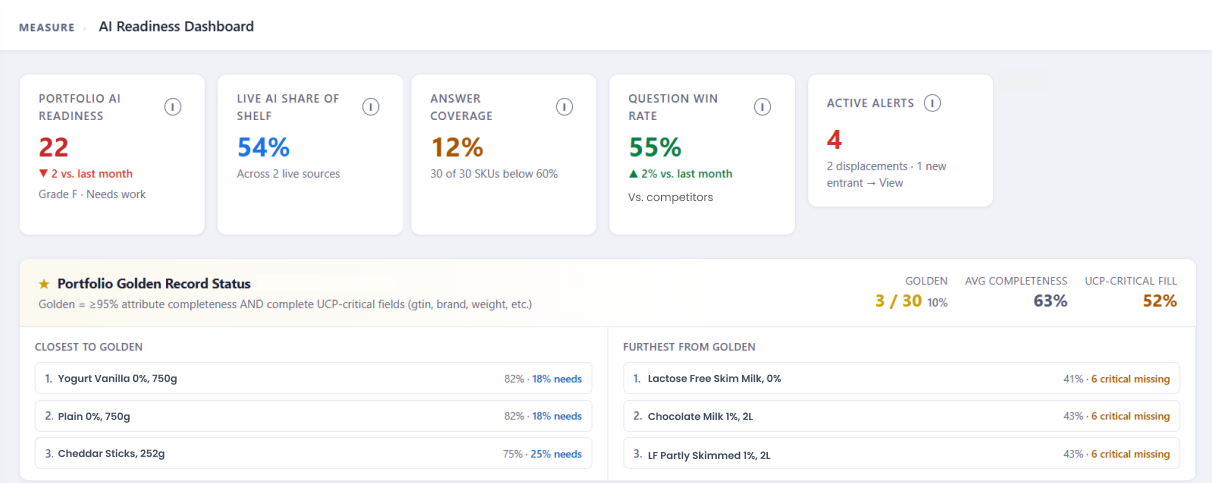
A dedicated AI readiness dashboard gives brands a single view of how their portfolio scores against AI discovery criteria: an AI readiness grade, live AI share of shelf across engines, answer coverage rates, question win rates versus named competitors, and a golden record metric that tracks how many SKUs meet the attribute completeness threshold AI systems require.
Monitoring data feeds directly back into audit rules and prioritization logic. If a particular attribute consistently correlates with higher conversion in a category, future scoring weighs that attribute more heavily. If certain title structures outperform others, those patterns inform future AI generation. The system improves with every cycle, building a compounding operational advantage.
AI can accelerate content creation at a speed and scale no human team can match. It can also introduce risk that, in enterprise environments, is not acceptable: unsupported claims in regulated categories, policy violations that trigger marketplace rejection, brand voice drift, and category logic errors any experienced editor would catch.
Governed AI is the framework that captures the productivity of AI generation while maintaining the accountability enterprises require. It operates as a three-stage pipeline. Data ingestion pulls raw product data from brand APIs and PIMs, live marketplace feeds, competitor catalog data, and retailer style guides. AI-driven content optimization processes this data within rule-based governance: LLM-powered text optimization rewrites titles, descriptions, and bullets; vision-based image enhancement scores image quality and generates alt text; a quality scoring engine applies content health scores by category and endpoint. Output and feedback runs a continuous cycle of optimization, monitoring, and governed publishing, with performance data flowing back to update scoring rules for the next cycle. The feedback loop is what separates this architecture from one-time AI enrichment tools.
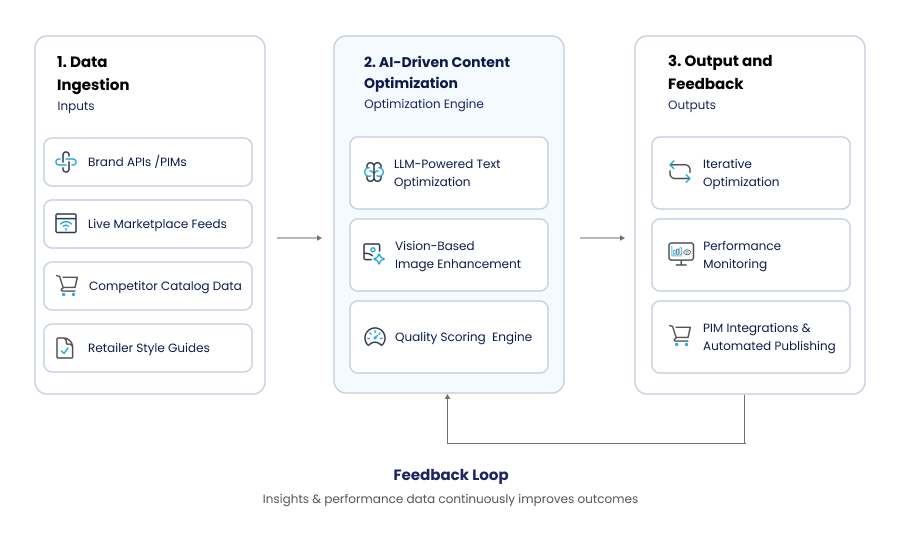
Rule-based scoring defines what good looks like by category, endpoint, and brand. Title rules, prohibited claim lists, required attribute fields, retailer character limits: all live in the governance layer and constrain what the AI can produce.
AI optimization within constraints generates improved titles, descriptions, attributes, and image enhancements faster and more consistently than manual copywriting. Prompt-driven customization adjusts tone and register for specific contexts: technical language for B2B buyers, simplified language for high-traffic consumer categories, or localized variations for international markets.
Competitive context ensures the AI does not optimize against an abstract standard of good content. It optimizes against the actual category environment: what top-performing competitors include in their titles, which attributes distinguish category leaders, and what content patterns correlate with strong performance. This prevents technically compliant but competitively inadequate content.
Content optimization sits at the intersection of the retailer-brand relationship. Both parties need high-quality product content. Both lose when AI discovery systems exclude their products for insufficient structured data. But they experience the problem from opposite directions.
For retailers and marketplaces, the challenge is scale and consistency. A retailer adding tens of thousands of SKUs monthly, across first-party inventory and third-party sellers, cannot manually validate content quality before listings go live. The result is inconsistency across categories, compliance issues discovered after the listing is live, and a long tail of products that never receive meaningful content investment despite contributing significant revenue. DataWeave addresses this through pre-launch audits that enforce style guides and flag missing attributes, continuous scoring with automated alerts when seller content drops below threshold, category-level dashboards that surface attribute gaps and seasonal opportunities, and AI-readiness alignment that structures attribute data for both classical search and AI answer engines.
For brands and manufacturers, the challenge is distribution integrity. A brand supplying content to 50 retailers has no direct control over how each retailer displays that content. Retailers modify titles, crop images, alter descriptions, and omit attributes, often with no notification to the brand. The result is inconsistent brand presentation that erodes trust and undermines premium positioning, often invisibly. DataWeave addresses this through multi-retailer audits that show how products actually appear across platforms, automated generation of retailer-specific title and description variations, competitive benchmarking that identifies what content elements drive conversion, and rule-based review that flags prohibited claims before content reaches any channel.
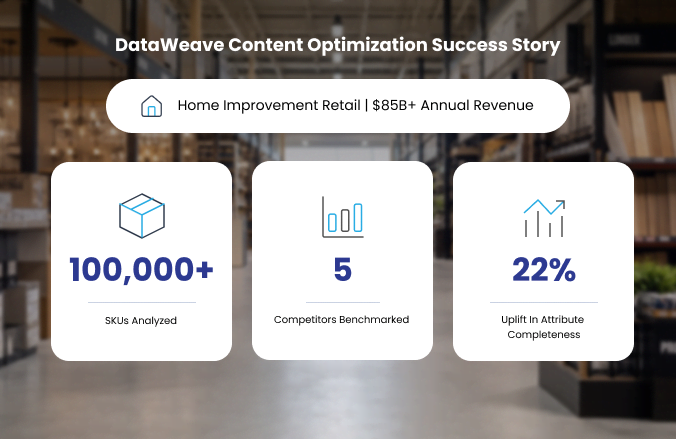
A leading home improvement retailer with $85B+ in annual revenue and a six-figure SKU catalog spanning home decor, appliances, tools, building materials, and seasonal products partnered with DataWeave to address a growing content quality challenge. While content standards existed internally, enforcing them consistently across categories, suppliers, and frequent updates had become unmanageable through manual processes.
The deployment covered 100,000+ SKUs across diverse categories including air filters, accent cabinets, rugs, and dozens of others. DataWeave benchmarked content against five major competitors, applied attribute health scoring based on completeness, accuracy, and category-specific best practices, and generated AI-driven recommendations for titles, bullets, marketing copy, and missing attribute values.
The result was a 22% uplift in attribute completeness across the catalog, measured as the percentage of missing attributes filled using DataWeave-recommended values. Coverage improved across critical specifications including dimensions, materials, compatibility, and technical features. Just as importantly, the retailer gained ongoing competitive visibility: SKU-level and PDP-level readiness tracking, attribute-by-attribute gap reports against competitors, and the ability to measure the impact of content updates over time, replacing a one-time cleanup mindset with a continuous optimization system.
Content optimization is not owned by a single function. The challenge touches every team responsible for product data, seller relationships, search performance, and category health.
Merchant Operations uses the platform to audit and standardize content at catalog scale, address rule violations quickly, and enforce content guidelines with third-party vendors. Catalog Onboarding validates content before listings go live, enforces retailer style guides automatically, and monitors post-launch quality. Marketplace Operations onboards content from multiple sellers, automates feedback to sellers, and enforces compliance across third-party listings. Category Management ensures content consistency across the category, identifies and fixes poor-performing content, and supports merchandising and seasonal optimization. Search Optimization ensures listings are search-engine-ready, aligns content with actual consumer search queries, and structures attribute data for AI answer engine visibility.
When content scoring is continuous and shared across teams, the dynamic changes from "who owns this problem" to "here is the prioritized fix list, routed to the right team." That operational shift is what allows content quality to scale with catalog growth rather than lagging behind it.
Most organizations already know their content has gaps. The harder question is where they sit in the maturity progression and what the next level requires.
The critical leap is not from Level 3 to Level 4. It is from Level 2 to Level 3: the shift from campaign-style projects to a continuous system of record with governed workflows. The diagnostic question is simple: is content quality a continuously measured metric with a named owner, or is it a problem that surfaces when something goes wrong? If the honest answer is the latter, the organization is operating at Level 2 regardless of how frequently the quarterly cleanup occurs.
DataWeave is designed to move organizations from Level 2 to Level 3 quickly, then to Level 4 as competitive benchmarking and performance monitoring data compound over successive cycles.
The content optimization market has a range of tools: generic AI writing assistants, standalone PIM solutions, SEO platforms with basic content scoring, and custom-built internal systems. What distinguishes DataWeave is the combination of retail data depth, category intelligence, and governed AI architecture that makes optimization trustworthy at enterprise scale.
DataWeave operates on live retail and marketplace data from 500+ endpoints, not static catalogs, so optimizations reflect what actually ranks and converts. It is purpose-built for retail and marketplaces, designed for millions of SKUs, long-tail assortments, and third-party sellers. Vertical-specific intelligence means content models and scoring rules are tuned by category, with deep expertise across grocery, electronics, CPG, apparel, home improvement, and more, not generic rules applied uniformly.
Governed AI combines rules-based scoring, structured prompts, and AI generation within approved guardrails, ensuring compliance, brand safety, and voice consistency at scale. Competitive context is native: content is optimized relative to actual category leaders, not abstract best practices. Parity monitoring tracks content drift between rendered pages, structured data, and syndicated feeds, the trust signals that increasingly determine whether AI systems include or filter out a listing. And enterprise-grade integrations with PIMs, CMSs, syndication feeds, and APIs mean it works within existing infrastructure with no rip-and-replace required.
Product content is no longer about making the PDP better. It is about operating a continuous system that ensures products remain discoverable, compliant, and compelling in an environment where shoppers seek certainty, retail algorithms reward quality and relevance, and AI discovery systems synthesize recommendations from the structured data available.
The organizations that win in AI-driven commerce have made one decisive shift: from treating content as a periodic project to operating it as governed infrastructure. Four principles define the leaders:
DataWeave's Content Optimization Solution provides the data foundation, scoring intelligence, and AI tooling to make this operational, whether you are a retailer managing millions of SKUs or a brand ensuring consistent performance across dozens of distribution channels.
For accounts configured with Google ID, use Google login on top.
For accounts using SSO Services, use the button marked "Single Sign-on".