AI Search and the New Digital Shelf: The Measurement Layer Brands Now Need for Product Discovery
8th Jun, 2026

By Vaibhav Khaparde
A year ago, traffic from AI engines was quite poor for retailers and brands. By March 2026, however, that had flipped. AI-referred visitors converted 42% better than traditional channels, stayed 48% longer on site, and viewed 13% more pages per visit. The volume grew alongside the quality: up 393% year over year in Q1 2026, and 693% across the 2025 holiday season.
Most brand teams know this channel is growing. What they don’t have is any way to see how they perform in it. Brands don’t know whether an AI engine is recommending your products, which competitors it’s recommending as well, or which queries are routing around you entirely. The channel that now converts better than paid search is also the one with the least visibility infrastructure around it.
And the gap runs deeper than just “we’re not tracking AI search yet.” Even brands that start measuring will find that a single AI visibility number doesn’t tell them much. AI search has fragmented product discovery across interfaces that operate nothing alike. Open web engines, retailer-embedded assistants, and agentic commerce protocols each read product data differently, pull from different sources, and produce a different competitive picture. A brand can rank first on Perplexity and be invisible on Amazon’s Alexa for Shopping for the same query.
In this article, we look into this AI search visibility gap. We also address the fragmentation in AI platforms, why it matters, and what brands need to build to stop flying blind.
AI Search Is a Matrix, Not a Channel
The visibility problem is compounded by a less-discussed finding: the average U.S. retail product page scores just 66 out of 100 on machine readability. A third of typical PDP content is invisible to AI engines. The spread between the best-performing and lowest-performing retail sites is vast, 82.5% vs. 54.2% for homepages alone.
Brands are competing for AI visibility they cannot measure, using product content that AI systems may not be able to fully read. And that visibility fragments across at least three distinct types of AI interfaces, each with its own data sources, its own signals, and its own competitive landscape.
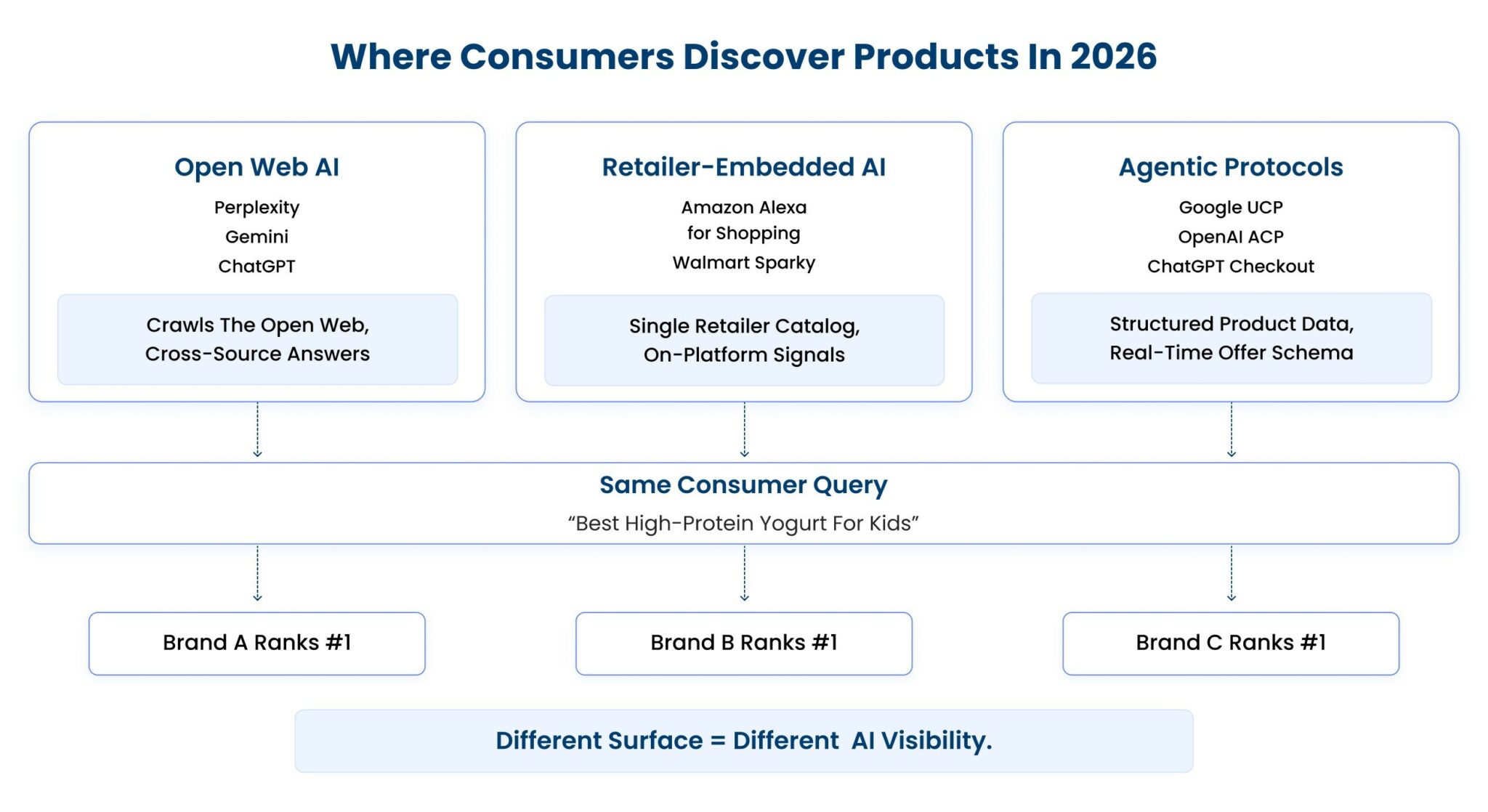
- Open web AI includes Perplexity, Gemini, and ChatGPT used as general-purpose search. A consumer asks “best wireless earbuds under $100” and gets a curated answer assembled from product data, reviews, and content crawled from across the web. These engines don’t run on any single retailer’s data. They run on everything they can access. The signals that matter are content density, structured attributes, review sentiment, and how efficiently your page communicates verifiable claims within a machine’s token window.
- Retailer-embedded AI operates inside a single retailer’s ecosystem. Amazon’s Alexa for Shopping, which merged the former Rufus chatbot with Alexa+ in May 2026. Walmart’s Sparky. Target’s shopping assistant. When a shopper asks Alexa “best protein yogurt for kids,” it recommends from Amazon’s catalog using Amazon’s data: product attributes, Q&A sections, review corpus, availability, pricing. It doesn’t care what Perplexity thinks. The competitive dynamics are entirely platform-specific, and they’re starting to include paid AI placements that don’t show up in traditional share of search tracking.
- Agentic commerce protocols are the newest and fastest-moving interface. Google’s Universal Commerce Protocol (UCP) now powers Universal Cart across Search, Gemini, YouTube, and Gmail. The UCP Tech Council has grown rapidly: Amazon, Meta, Microsoft, Salesforce, and Stripe joined in April 2026, alongside founding members Google, Shopify, Etsy, Target, and Wayfair. On the OpenAI side, the Agentic Commerce Protocol (ACP) still powers merchant integrations inside ChatGPT, though OpenAI discontinued its Instant Checkout feature in March 2026 after low adoption and shifted ChatGPT’s role toward product discovery with merchant-controlled checkout. The infrastructure is real and expanding. But these protocols require genuinely different data plumbing than traditional digital shelf optimization: real-time offer schema, GTINs, structured shipping and return policies, inventory synced to the minute. If your product data isn’t built for these rails, agents filter you out at the discovery stage, before a shopper ever reaches checkout.
invisible on Alexa for Shopping for the same query. It can show up on ChatGPT’s open web results but get filtered out of Walmart-specific recommendations. The competitive landscape looks different on every interface.
If you’re measuring “AI search visibility” as a single number, you’re averaging across interfaces that have nothing in common. That average hides the gaps actually costing you.
What This Visibility Blind Spot Actually Costs
The data that powers AI recommendations is largely the same data Digital Shelf Analytics has tracked for years: content quality, pricing, availability, review sentiment, competitive positioning. Brands with strong DSA fundamentals are already sending the right signals into open web and retailer-embedded AI surfaces, whether they know it or not. DSA was built to measure the digital shelf as it exists on retailer search engines. It works. But AI search has added interfaces that sit outside that measurement frame, and share shifts are happening there right now, invisibly.
Consider what this looks like in practice.
- A competitor buys sponsored AI placements on Walmart’s Sparky for a keyword you’ve dominated organically. Your on-site share of search on Walmart.com looks stable. But consumers asking Sparky for recommendations in your category now see your competitor first. Without cross-surface visibility, you wouldn’t know this happened. With it, you’d see the shift the week it started: your visibility score on Sparky drops for that query while your on-site share holds steady. That divergence is the early signal. By the time it reaches your sales data, the competitor has already established positioning that’s harder to displace.
- Or: your brand dominates “best protein bars” on Perplexity but is invisible for “healthy lunchbox snacks for kids,” a query where competitor content is richer in use-case attributes and Q&A coverage. A PDP-level content audit won’t catch this, because the gap isn’t at the product level. It’s at the category and intent level. What catches it is tracking visibility by query across engines and seeing the blank space where your brand should appear.
- Or: a new competitor starts showing up in Perplexity’s recommendations for three of your top ten tracked queries. It wasn’t there last month. The only way to know this before it hits your revenue is to be running those queries against AI surfaces on a regular cadence and watching the results change.
These scenarios represent the kinds of competitive shifts that become visible once you can track AI visibility across surfaces, and stay invisible without that tracking.
The measurement itself works on two layers. First, content readiness: is your product data structured for AI agents to parse, evaluate, and cite? That means scoring each PDP on the signals agents actually weigh. How densely the page communicates verifiable claims within a token window. Whether structured attributes cover what consumers ask about: ingredients, use cases, compatibility, safety. Whether Q&A and review sentiment corroborate the product’s claims, or contradict them.
That last point matters more than most teams realize. A product with strong review sentiment around protein content is more likely to get recommended when a shopper asks “high protein yogurt.” But only if the listing’s structured attributes confirm the claim. When review signals and product data don’t align, agents treat the mismatch as a trust gap and route around the product. One failure mode, replicated across hundreds of SKUs, can suppress an entire portfolio’s AI visibility.
For a deeper look at what AI agents evaluate on product pages and the six content factors that drive citation share, read our companion piece on how the AI retrieval economy works.
Second, market visibility: where are your products actually showing up? That means running a defined set of category queries, the same queries you already track in share of search, across each AI interface on a regular cadence. Capturing whether your products appear, in what position, against which competitors, on which engine and retailer. Open web engines queried via their APIs. Retailer-embedded assistants tracked inside their respective environments. The output: a visibility score per query, per interface, trended over time.
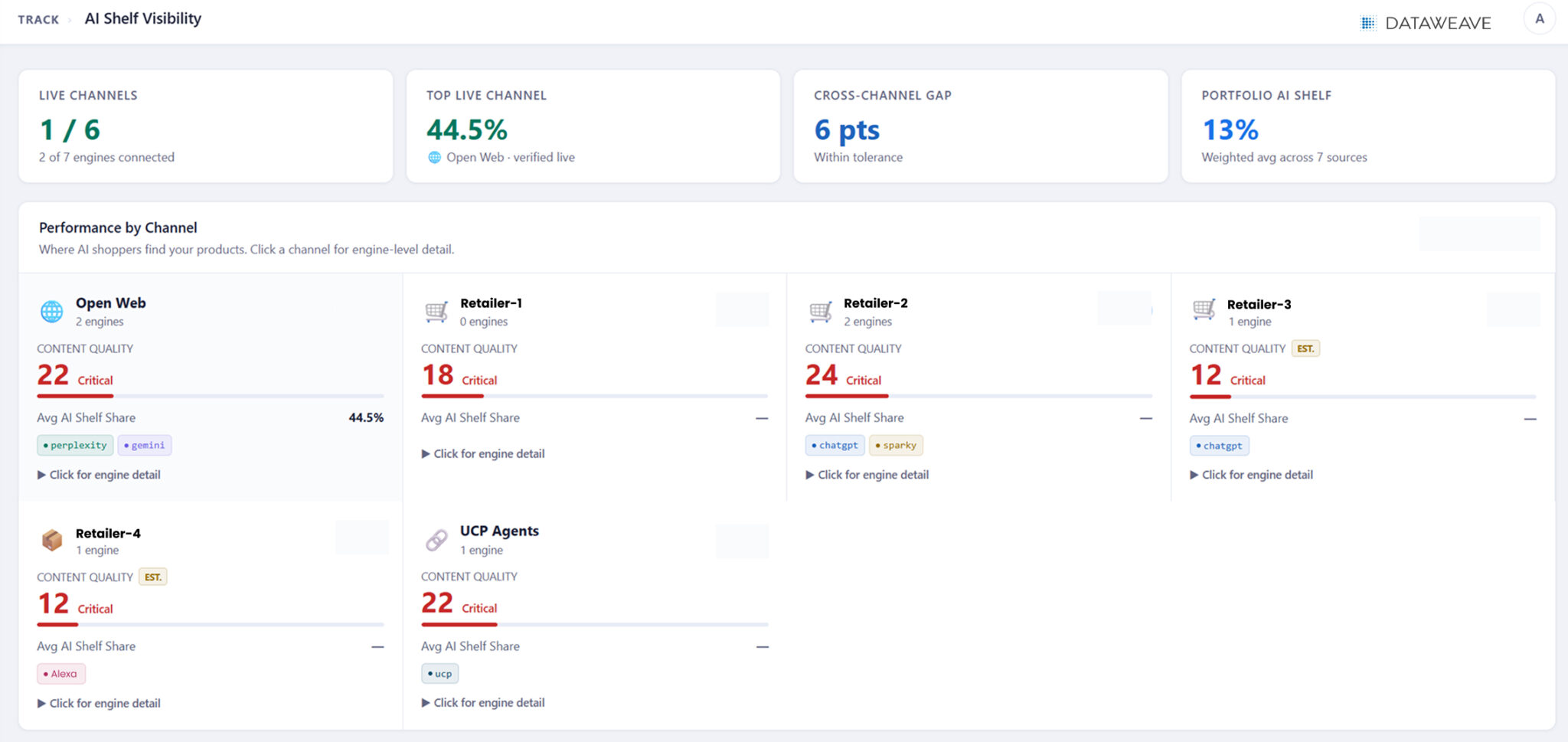
Because the query set mirrors what DSA already tracks on retailer search, the two views reconcile. You can watch a product lose AI recommendation share on the same queries where its on-site share looks stable. That divergence is the signal that a gap is opening on a surface your current dashboard doesn’t cover.
Google took a step toward this at I/O 2026. The new AI performance insights tool in Merchant Center lets brands compare share of voice on Google’s AI surfaces. It’s meaningful, but it covers Google alone. It doesn’t tell you what’s happening on Perplexity, Alexa for Shopping, or Sparky. For full AI visibility, brands need cross-surface measurement.
Building Your AI Visibility Baseline
Start with three moves.
Map your AI search interfaces.
Open web (Perplexity, Gemini, ChatGPT) is universal. Retailer-embedded AI depends on where you sell: Alexa for Shopping on Amazon, Sparky on Walmart. Agentic protocols (UCP, ACP) matter if your category has high-frequency repurchase behavior. With Google’s Universal Cart now tracking price drops and stock changes across merchants in the background, even consumers who aren’t actively searching can be served competitive comparisons while browsing YouTube or Gmail. Know the interfaces before you try to measure them.
Audit content for AI readiness, not just content scores.
Traditional audits check completeness: does the PDP have a title, description, images, and attributes? AI readiness asks different questions. Are your structured attributes specific enough for an AI agent to match against a query like “lactose-free milk that tastes good”? Do your Q&A sections cover what consumers actually ask? Are review signals consistent with product claims? Research from BrightEdge found that pages with properly implemented structured data are cited in AI Overviews at roughly 2.5 to 2.7 times the rate of pages without it. These signals determine whether an AI agent recommends your product or skips it.
Start tracking AI visibility for your top queries.
Pick ten high-value queries. Check whether your products appear in AI recommendations across open web engines and the retailer-embedded AI tools relevant to your category. The point is to find a baseline. If a competitor shows up in five of those ten queries and you show up in two, that’s a gap you need to see before it widens.
The Shelf Expanded. Measurement Has to Expand With It.
AI search isn’t replacing the digital shelf. It’s adding interfaces where product discovery happens, competitive dynamics that shift weekly, and signals that determine which products get recommended.
DSA becomes your foundation, with AI visibility tracking as its natural extension. The content quality, pricing accuracy, availability, and competitive positioning that DSA measures are the same signals AI engines evaluate. What’s new is the ability to track whether those signals are translating into AI recommendations, on which surfaces, for which queries, and against which competitors.
This is the gap DataWeave’s AI visibility tracking is built to close: content readiness scoring connected to the same data quality metrics DSA already monitors, cross-surface visibility measurement across open web, retailer-embedded, and agentic interfaces, competitive gap analysis at the engine and query level, all in a single view. Where your products stand in AI-driven discovery, what’s changing, and where to act.
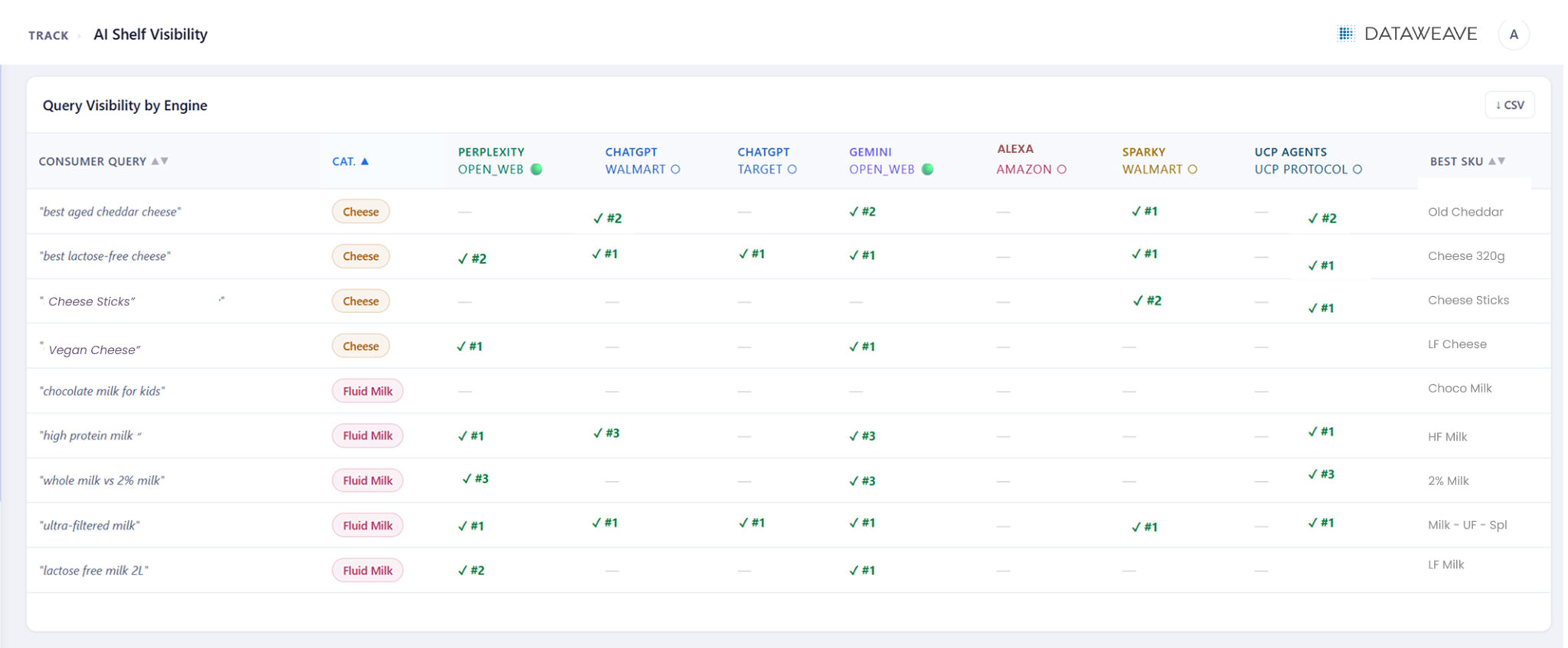
The brands that build this measurement layer in 2026 will compound an advantage their competitors will spend years trying to close. Want to see how your brand’s AI visibility stacks up across search surfaces? Talk to us today.



Login
For accounts configured with Google ID, use Google login on top.
For accounts using SSO Services, use the button marked "Single Sign-on".