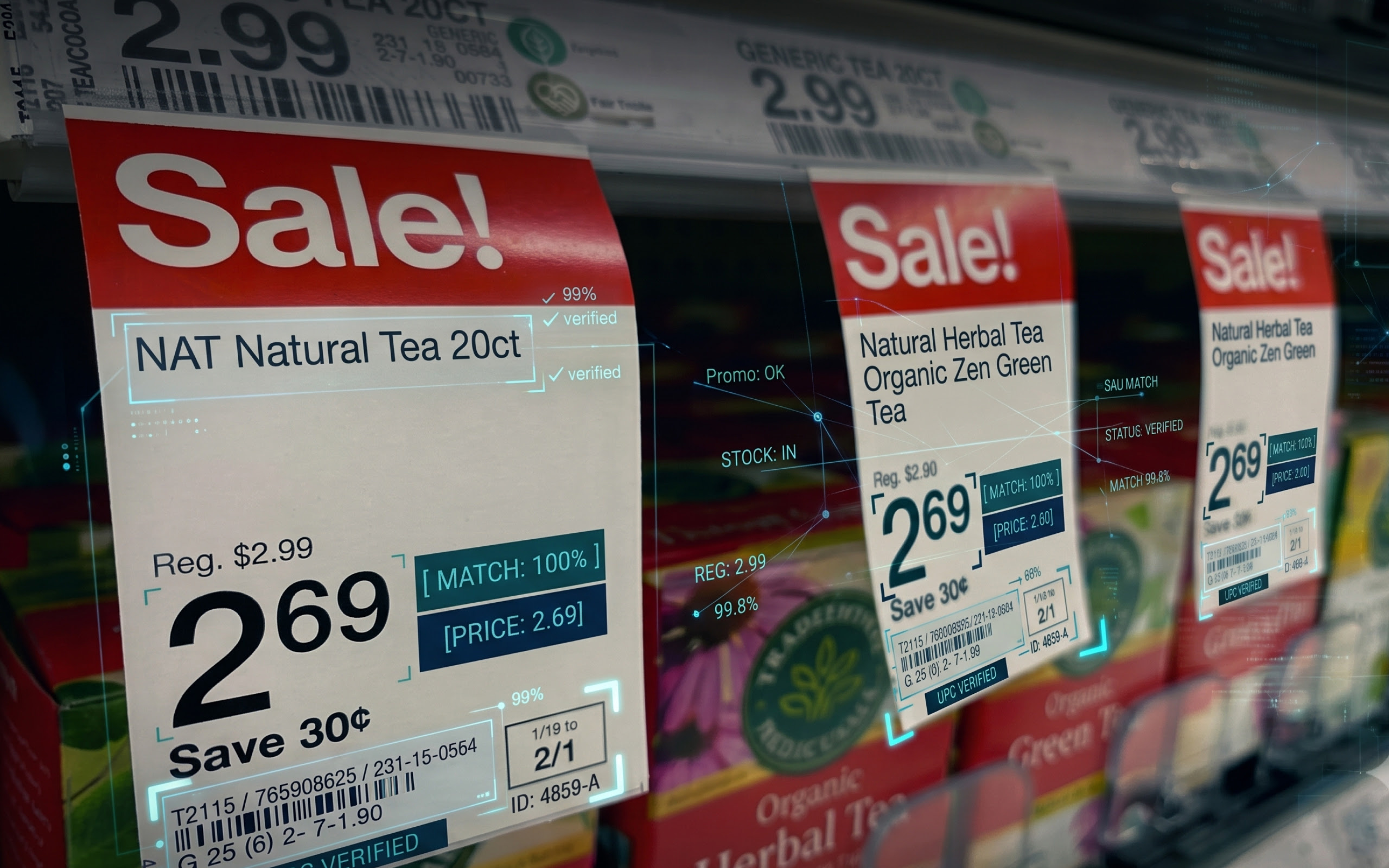
The Data Input Layer That Makes Pricing Decisions Defensible
24th Sep, 2026

By Sadananda Vaidya
Part 1 of 4 in a series on the data layer behind defensible retail pricing.
Every pricing team eventually faces the same question: “Why this price, and how do you know it’s right?” The first half is easy. A model can explain it with an elasticity curve or a competitive based rule. The second half is harder, because “how do you know it’s right,” isn’t really about the model at all. It’s about the data the model was built on, and most pricing teams never actually examined that data. They just inherited it.
Over the next three posts, this series is going to open up exactly what that data has to get right: contextual data at the retailer schema level and attribute normalization (Part 2), promotion type coding and availability signal at the store and ZIP level (Part 3), and assortment overlap tracking with content quality inputs (Part 4). Taken separately, each reads like a data engineering nice to have. Taken together, they’re not four separate capabilities so much as one input layer, and it’s the layer that determines whether “why this price” has a real answer or a shrug.
Why Automated Pricing Engines Fail – The Data Input Problem
It’s tempting to think of a pricing engine as its optimization logic: the elasticity model, the competitive-response rules, the margin constraints. That logic is usually the least fragile part of the stack. The failures that actually get a pricing recommendation reversed in a leadership meeting almost always trace back to the data underneath it, not the math on top:
- A competitive price comparison that was actually comparing two different products, because attribute normalization treated an 8kg and a 9kg washing machine as the same SKU.
- A “competitor is discounting harder than us” alert that fired because a loyalty-linked member price was compared against a public shelf price, with no distinction between an offer every shopper can get and one only a fraction can.
- A recommended price increase that ignored the fact that the competing SKU had been out of stock at the relevant stores for two weeks, so the “competitive” price it was reacting to wasn’t actually available to any shopper.
- An assortment-based margin opportunity that evaporated because the two products flagged as competitors were actually variants with a real cost and feature difference between them.
- A content blind price cut on a product that was actually underperforming because of a missing product image and an incomplete spec, not because it was priced wrong at all.
None of these are pricing-model failures. They’re failures of the input layer, and they’re the reason a pricing recommendation that looks statistically sound can still be wrong in a way that costs margin and, worse, costs the pricing team’s credibility the next time they bring a number to the room.
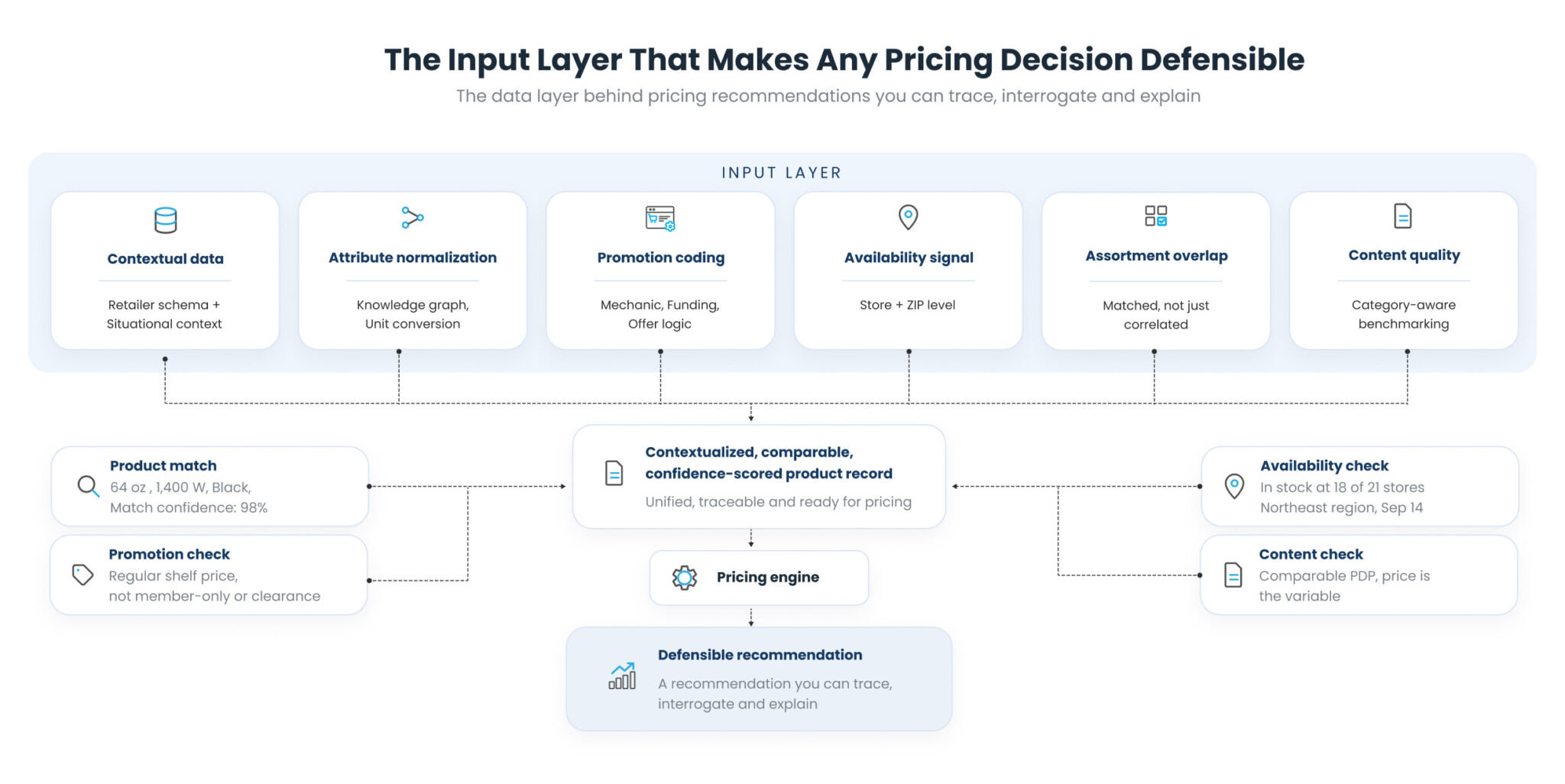
What Makes an Automated Pricing Recommendation Truly Defensible?
It’s worth being precise about what “defensible” means here, because it’s easy to let it collapse into a synonym for “accurate,” and that’s not quite it. A defensible pricing recommendation is one where every input that fed it can be traced back to a specific, contextualized, confidence-scored observation (this retailer, this store or ZIP, this date, this exact promotional mechanic, this exact matched product) rather than an aggregate number with the provenance stripped out.
That traceability is what lets a pricing team answer follow-up questions instead of just the first one. “Why this price” gets an answer from the model. “Which specific competitor listings is this based on, are you sure they’re the same product, and were they actually in stock when we compared?” only gets answered if the input layer preserved that lineage all the way through, which is exactly what contextual data, in the sense we’ll unpack in Part 2 of this series, is for. Strip that context out to make the pipeline simpler, and you save engineering effort at the direct cost of every conversation where someone senior asks a second question.
This is also why “defensible” scales differently than “accurate.” A model can be statistically accurate on average while still being indefensible on any individual recommendation someone chooses to interrogate, and pricing decisions get interrogated one SKU at a time, in category reviews and leadership meetings, not in aggregate. The input layer’s job is to make every individual recommendation traceable, not just the portfolio average correct.
Walking one recommendation back through the layer
Here’s a preview of what that looks like in practice, before we go layer by layer in the rest of this series. It’s worth tracing a single pricing recommendation all the way down, because that’s the exercise a defensible input layer is actually built for. Say the recommendation is: match a competitor’s price on a specific blender model at a specific retailer this week.
Contextual data confirms which retailer, which region, and which schema version the competitor’s listing came from: not just “a competitor,” but a specific, source-attributed record. Attribute normalization confirms the competing listing is actually the same blender, same jar capacity, same motor wattage, not a lower-tier variant that happens to share a brand name.
Promotion coding confirms whether the competitor’s price reflects a standing shelf price or a time-boxed clearance mechanic that will expire before your own price change would even take effect.
Availability confirms the competing SKU is actually in stock at the stores and ZIP codes relevant to the comparison, not a phantom price attached to an empty shelf.
Assortment overlap confirms this is genuinely a one-to-one competitive match and not two products the matching engine only thinks are equivalent.
Content quality adds one more check worth asking: if the competitor’s listing is outperforming despite a comparable price, is content the actual reason, in which case matching the price alone won’t close the gap.
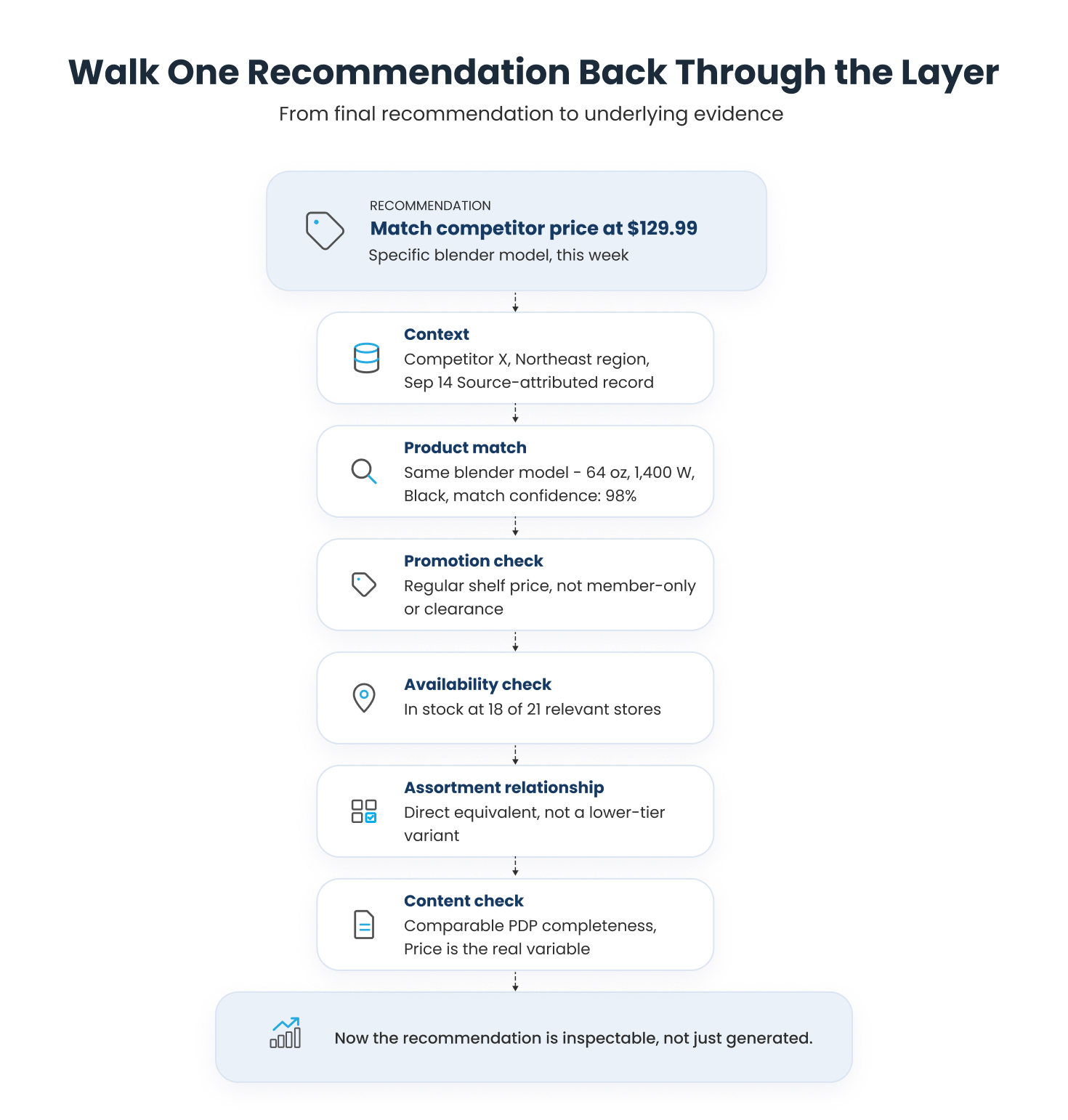
Only once all six checks are clear does “match this price” become a recommendation a pricing lead can put in front of a category review and answer every follow-up question on. Skip any one of the six, and the recommendation is still generated, still looks precise, and is one pointed question away from falling apart.
Why this is a harder problem than most teams budget for
Every one of the six layers we’ll cover in this series involves the same pattern: something that looks like a formatting or cleaning problem on the surface turns out to require domain-specific machinery underneath: a category-aware knowledge graph, human-in-the-loop verification, multimodal extraction from both text and images, geographically distributed availability observation, match-aware benchmarking.
That pattern is important because retail data is adversarial to standardization by nature. Every retailer has independently optimized its own schema, its own promotional language, and its own merchandising conventions, none of which were built with cross-retailer comparability in mind. Building the input layer means reconciling that independence at scale, continuously, as retailers change their sites, their taxonomies, and their promotional mechanics without notice.
This is also why the input layer tends to get underinvested in relative to the pricing model sitting on top of it. A pricing model is a bounded, visible engineering project with a clear owner and a clear deliverable. The input layer is a continuous, unglamorous operating discipline (crawling, matching, tagging, verifying, re-verifying as retailers change) that never really finishes, and it’s much easier to defer than to build, right up until a recommendation gets challenged and there’s no lineage behind it.
Why this matters, at the level a leadership team actually asks about
For a pricing or revenue leader, the practical payoff of getting this layer right is much more than just a better-looking dashboard. It means fewer reversed decisions, fewer defensive scrambles in category reviews, and a pricing function that can say, specifically, what it’s comparing and why, every time it’s asked.
For a brand or retailer building or buying pricing intelligence, the diligence question worth asking a vendor isn’t “how good is your model,” it’s “walk me through what happens to a promotion I’ve never seen before, a product with no clean identifier, and an out-of-stock competitor SKU, before any of that data reaches the pricing engine at all.” The answer to that question is the input layer, and it’s the actual place where pricing intelligence is won or lost.
That’s the layer this series is about to open up, end to end, and it’s the layer DataWeave builds. We’ll start at the bottom of the stack in Part 2: what “contextual data” actually means once you get down to the retailer schema level, and why attribute normalization has to be treated as a domain problem, not a formatting one.
If you’re evaluating whether your pricing engine’s foundation would hold up to that question, we’re glad to walk through it against your own catalog. Reach out to our team today to know more.




Login
For accounts configured with Google ID, use Google login on top.
For accounts using SSO Services, use the button marked "Single Sign-on".