
AI Visibility Interactive Dashboards: What AI Assistants Recommend Across Key US Categories
5th Oct, 2026

By DataWeave Marketing
The digital shelf is changing. For years, brands competed to appear on the first page of search results, rank on retailer sites and win the product carousel. Now shoppers can skip the list of links altogether and ask an AI assistant what to buy.
- What’s the best butter for baking?
- Which bread is best for sandwiches?
- What’s a good moisturizer for sensitive skin?
- Which Bourbon should I bring to a dinner party?
Instead of returning hundreds of possibilities, AI narrows the field to a handful of recommendations. That raises a new question for consumer brands: when AI decides which products deserve a recommendation, which brands make the cut?
That question grows more urgent every season. Over the 2025 holiday season, traffic from generative AI tools to US retail sites rose 693.4% year over year, according to Adobe.
To serve this need for our customers, DataWeave launched AVA, or AI Visibility Analytics, to help brands see how they show up across AI-driven shopping journeys and improve it. AVA measures how brands show up across AI assistants at scale, inside the categories and shopper needs that matter to each business: where a brand ranks, which competitors get recommended next to it, and which sources the assistants draw on to justify the pick.
We recently launched interactive dashboards that provide high-level summaries of AI shelf visibility of brands for popular shopping categories, built on the AVA platform. Each dashboard starts with a set of unbranded shopper questions written the way people actually ask them, like “best butter for baking” or “which yogurt is best for a high-protein breakfast”.
We ran every question through ChatGPT, Claude, Gemini, and Perplexity in the US with no personalization, then logged each product the assistants named along with its position in the answer, its brand and parent company, and the sources the assistant cited. Across dairy, bakery, beauty, and spirits, that comes to 2,200 prompts and 67,478 ranked recommendations.
One measure ties the categories together. AI Recommendation Coverage (ARC) is a brand’s share of all recommendations in its category, across every prompt and every assistant. We track first-place answers separately, because a brand named eighth is on the list in a very different way from the brand named first. A static report would freeze those numbers on one page, so each category got an interactive dashboard where you can filter by assistant, sub-category, and shopper need and see where the gaps open up.
The patterns below held across all different aisles. After them, you’ll find each dashboard with its sharpest finding and a link to explore the full data.
EXPLORE THE INTERACTIVE AI SHELF
Five Key Patterns Across The AI Shelf
1. No brand owns more than 6% of any AI shelf
The most-recommended brand in each category holds a thin slice.
- CeraVe leads beauty with 5.8% of recommendations,
- Dave’s Killer Bread leads bakery with 4.5%,
- Organic Valley leads dairy with 4.1%,
- and Kirkland Signature leads spirits with 2.7%.
Spirits is the most crowded of all categories: assistants named 2,223 brands, and the top ten share 19% between them. On a shelf split this finely, a point or two of coverage moves a brand from the middle of the pack to the top of the leaderboard.
2. Getting mentioned and getting picked first are separate races
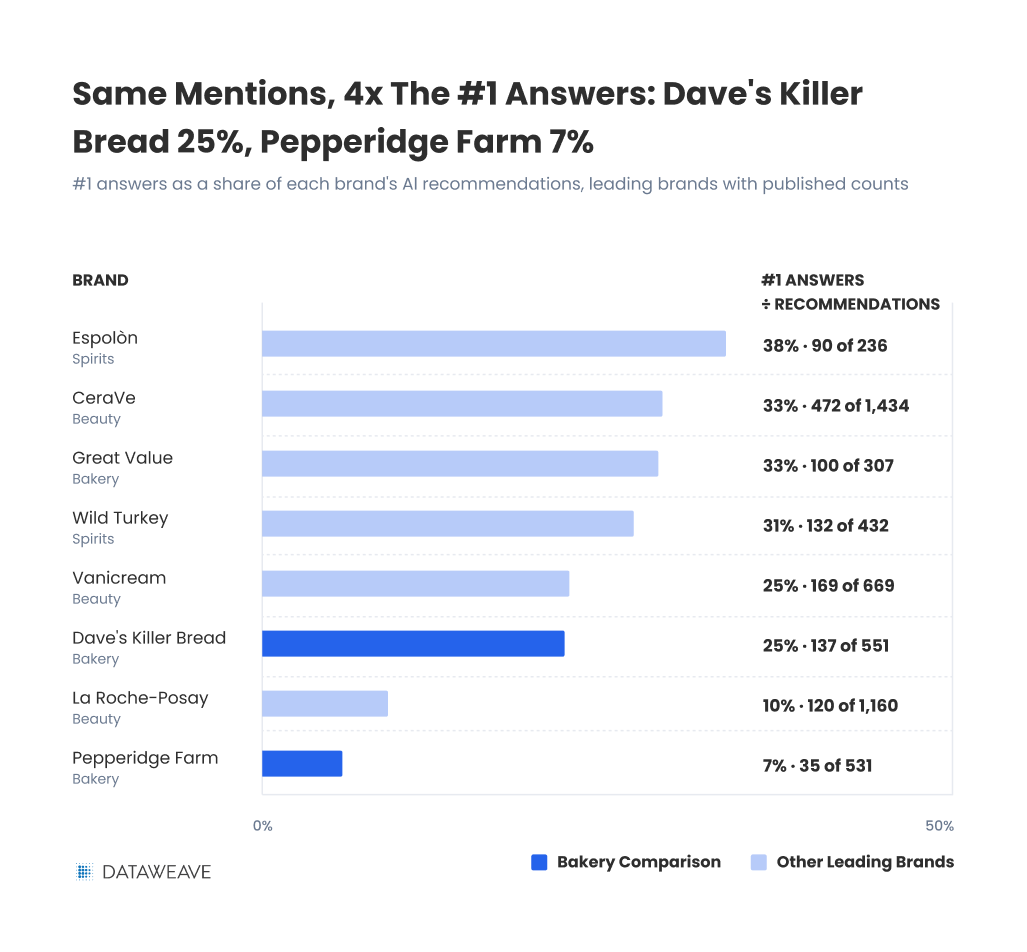
- Dave’s Killer Bread and Pepperidge Farm show up in almost the same number of answers, 551 and 531, yet Dave’s Killer Bread takes the #1 slot 137 times to Pepperidge Farm’s 35.
- CeraVe and La Roche-Posay show the same split in beauty.
A brand that only tracks how often it appears is missing the number that decides which product the shopper clicks first.
3. Store brands compete on the AI shelf at full strength
Private labels rank near the top in three of all categories.
- Kirkland Signature is the single most-recommended spirits brand.
- In bakery, six of the top 14 brands belong to retailers (Trader Joe’s, Great Value, Kirkland Signature, Favorite Day, Marketside and Kroger), and together they collect 1,306 recommendations, more than the two national leaders combined.
- In dairy, Kirkland Signature, Good & Gather and Great Value all sit in the top seven.
AI assistants treat a store brand as a legitimate answer to a shopper’s need, on the same footing as any national label.
4. Each assistant runs its own shelf
Visibility of one AI assistant tells you little about the next.
- Target’s Favorite Day takes 2.9% of ChatGPT’s bakery recommendations and 0.4% of Claude’s.
- Good & Gather is ChatGPT’s most-recommended dairy brand at 6.4%, then falls to 1.5% on Perplexity.
- Buffalo Trace earns 127 first-place answers in spirits, and only 3 of them come from ChatGPT.
An average across all the AI assistants smooths these gaps out of sight.
5. Retail product pages supply the evidence, and Gemini hides its sources
When assistants cite where a recommendation comes from, retailer pages dominate.
The leading retail sites account for 5,290 bakery citations and 3,239 dairy citations, and totalwine.com alone supplies 4,485 in spirits. Brand-owned websites barely register outside beauty. Gemini routed its citations through grounding redirects in every category, 15,677 of them across the dashboards, so nobody outside Google can audit where its answers come from.
Interactive AI Visibility Dashboards – Quick Browse
US Dairy: The Ownership View Rewrites The Leaderboard
- 400 prompts across milk, cheese, butter, and yogurt
- 12,493 ranked recommendations
- 1,083 brands
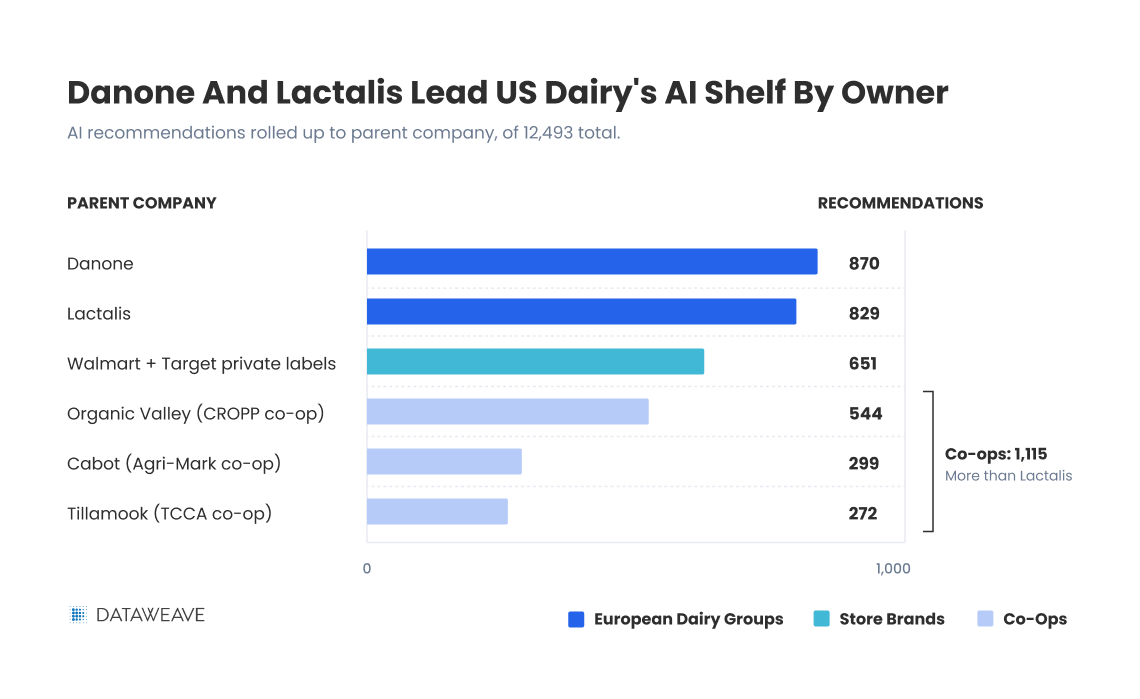
Organic Valley tops the dairy brand leaderboard, and it gets there on breadth: it ranks in the top five in three aisles without leading any of them. Roll the same recommendations up to the companies that own the brands, and two European groups move to the front.
Danone (Horizon, Silk, Oikos) and Lactalis (Stonyfield, Siggi’s, Galbani) outrank every US owner because they field a brand in almost every aisle. Walmart’s and Target’s private labels, counted together, would rank third. Organic Valley also turns out to be the steadiest brand on this shelf, the only one in the top 15 that clears 4% of recommendations on all four assistants.
Explore The AI Shelf: US Dairy dashboard
US Bakery: Different AI Assistants Cite From Different Sources
- 400 prompts across bread, bagels, buns and cookies
- 12,229 ranked recommendations
- 1,318 brands
Bakery recommendations lean hard on retailer product pages. Ten retail sites, led by Walmart, Target, and Kroger, supply 5,290 citations, and no brand-owned website makes the list. Which retailer an assistant reads depends on the assistant.
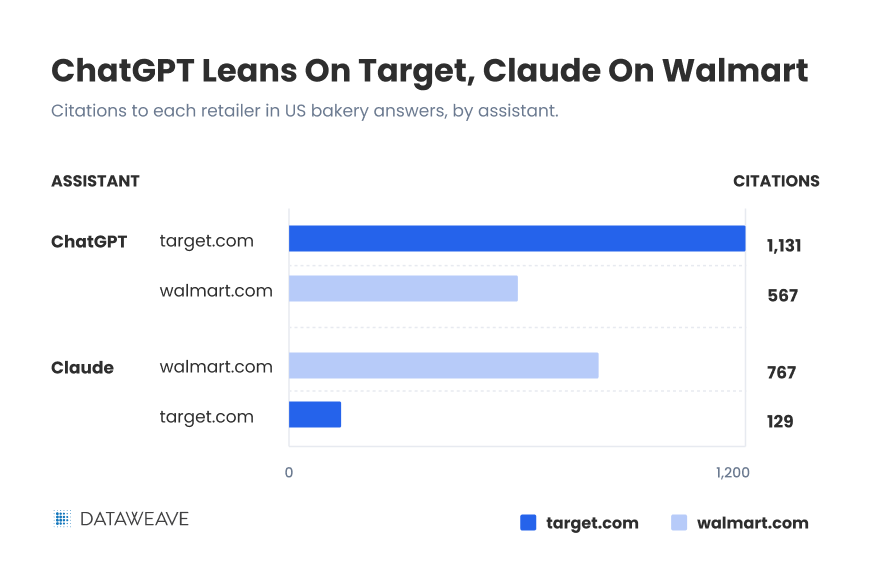
ChatGPT cites target.com about twice as often as walmart.com. Claude flips the order and cites Walmart roughly six times as often as Target. A bakery brand with a strong Target product page and a thin Walmart one will look healthy on ChatGPT and weak on Claude, from the same catalog. On the ownership side, Bimbo Bakeries (1,435 recommendations) and Flowers Foods (1,256) together hold 22% of every recommendation in the category.
Explore The AI Shelf: US Bakery dashboard
US Beauty & Personal Care: The Category Where Brand Websites Count
- 800 prompts across skincare, haircare, makeup and deodorant
- 24,550 ranked recommendations
- 1,671 brands
CeraVe leads beauty by a wide margin, with 1,434 recommendations and 5.8% of the shelf against La Roche-Posay’s 1,160. It also wins first place far more often, including 45% of every #1 answer for moisturizers. Beauty is the one category in this series where the brands’ own websites show up as evidence.
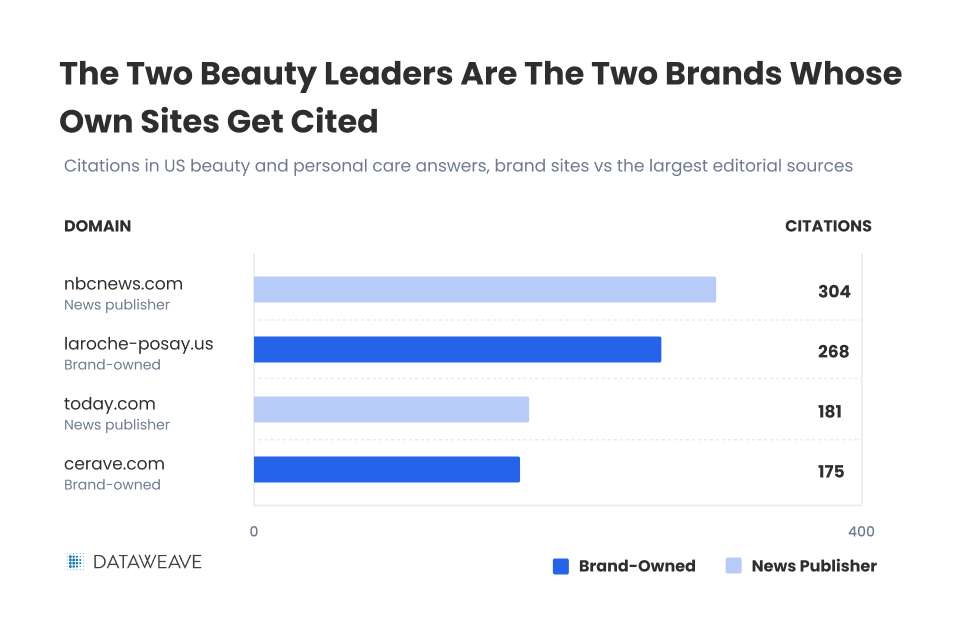
In dairy, Organic Valley’s site is the only brand domain in the top 14 sources, and Reddit outranks it. In the bakery aisle, no brand site appears at all. But here, laroche-posay.us and cerave.com sit alongside the biggest editorial sources, and they belong to the two most-recommended brands in the category. Ownership is concentrated too: L’Oréal alone accounts for 4,507 recommendations, 18% of the shelf and more than Unilever and Procter & Gamble combined.
Explore The AI Shelf: US Beauty & Personal Care dashboard
US Spirits & Wine: A Store Brand on Leads With One Retailer Behind The Answers
- 600 prompts across whiskey, bourbon, vodka, rum, tequila and wine
- 18,206 ranked recommendations
- 2,223 brands
Spirits is the most fragmented shelf in the series. Kirkland Signature leads with 494 recommendations, 2.7% of the total, just ahead of Wild Turkey at 432. Eight of the top nine brands are whiskey or bourbon. The evidence behind those answers comes overwhelmingly from one place.
totalwine.com accounts for 4,485 citations, and 2,880 of them come from ChatGPT. Enthusiast publications matter in spirits, and the five largest together out-cite target.com and walmart.com, yet they still add up to a fraction of one retailer’s pull. For a spirits brand, the Total Wine product page may be the most important page it doesn’t own. Further down the leaderboard, Espolòn turns 38% of its 236 mentions into first-place answers, a rate no whiskey on the list matches.
Explore The AI Shelf: US Spirits & Wine dashboard
See the full AI shelf for your category
AI answers can change with the prompt, model, and time of testing, so it’s essential for brands to have granular data on their ARC on an ongoing basis.
Our interactive dashboard goes much deeper than what’s shared in this article, covering category rankings, parent companies, retailer sources, and demand spaces. Browse every dashboard on the Interactive Dashboards page or talk to our team to find out where your portfolio stands on the AI shelf.

Login
For accounts configured with Google ID, use Google login on top.
For accounts using SSO Services, use the button marked "Single Sign-on".