AI Visibility of Dairy Brands: Who Wins When Shoppers Ask AI What to Buy?
5th Oct, 2026

By DataWeave Marketing
The digital shelf is changing. For years, brands competed to appear on the first page of search results, rank on retailer sites, and win the product carousel. Now, shoppers can skip the list of links altogether and ask an AI assistant what they should buy.
- What’s the best butter for baking?
- Which yogurt is best for a high-protein breakfast?
- What’s a good organic milk for kids?
Instead of returning hundreds of possibilities, AI can narrow the field to a handful of recommendations. That creates a new question for consumer brands: When AI decides which products deserve to be recommended, which brands make the cut?
Answering that question is becoming increasingly urgent for brands seeking to build or protect their competitive position across product discovery and conversion. To help brands understand and improve how they appear across AI-driven shopping journeys, DataWeave recently launched AVA, or AI Visibility Analytics.
AVA enables brands to measure their visibility across AI surfaces at scale, within the categories and shopper needs most relevant to their business. Using the platform, we have also developed a series of interactive dashboards that benchmark how brands appear, where they rank, which competitors are recommended alongside them, and what sources support those recommendations.
This article explores the key findings from our Dairy AI Visibility dashboard, designed as a sampler of the solution, from a one-time snapshot. We analyzed 400 unbranded shopper prompts across milk, cheese, butter, and yogurt, with 100 prompts dedicated to each category. Rather than focusing on a narrow set of product keywords, the prompts were written to reflect natural shopping questions across 10 demand spaces, capturing the different needs and considerations that can shape a purchase.
We ran every prompt across ChatGPT, Claude, Gemini, and Perplexity. The research generated 12,493 ranked recommendations across 1,083 normalized brand labels, providing a detailed view of which brands make the AI-generated shortlist, how prominently they appear, and how those results differ across categories, shopper needs, and AI assistants.
EXPLORE THE INTERACTIVE AI DAIRY SHELF
Key Findings1. Visibility and the #1 spot are two different wins
The AI Recommendation Coverage (ARC) in our dashboard shows how often and how high a brand appears. The #1 share shows how often it becomes the AI assistant’s first recommendation pick.
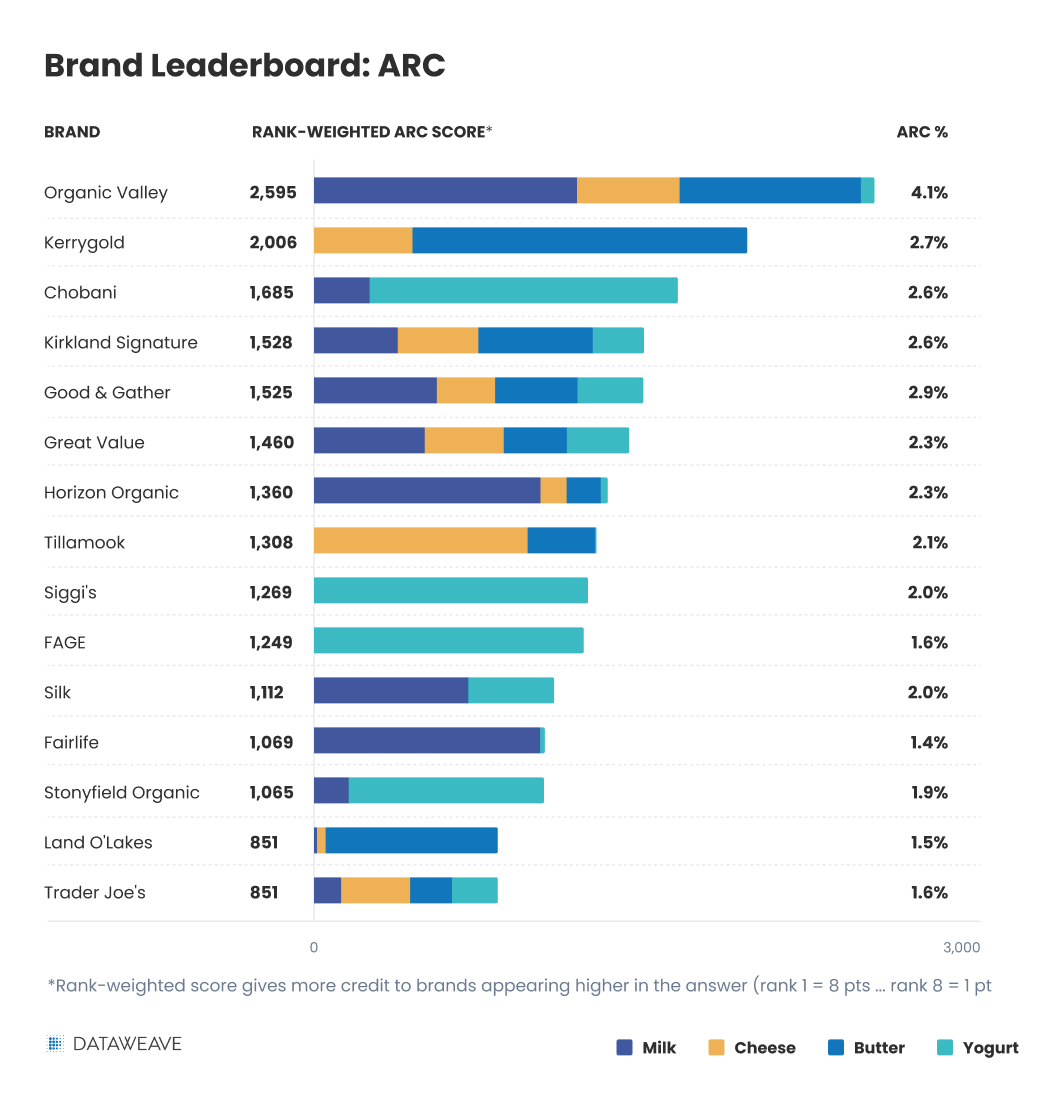
- Organic Valley leads overall ARC, 29% ahead of Kerrygold. It ranks in the top five in three categories without leading any of them.
- Fairlife ranks 14th overall, yet it wins 15% of the #1 spot in milk, more than any other milk brand.
- Some brands own the top slot in a single category. Kerrygold takes 29% of #1 recommendation in butter, and FAGE takes 25% in yogurt.
Being cited as #1 and overall ARC (recommendation share) are both useful when assessing where a brand appears in AI answers.
2. Your AI competitors may not be the ones you track
AI assistants answer the shopper’s need or intent. That puts store brands and dairy alternatives in the same answer as national brands, or any other brands that fit the bill.
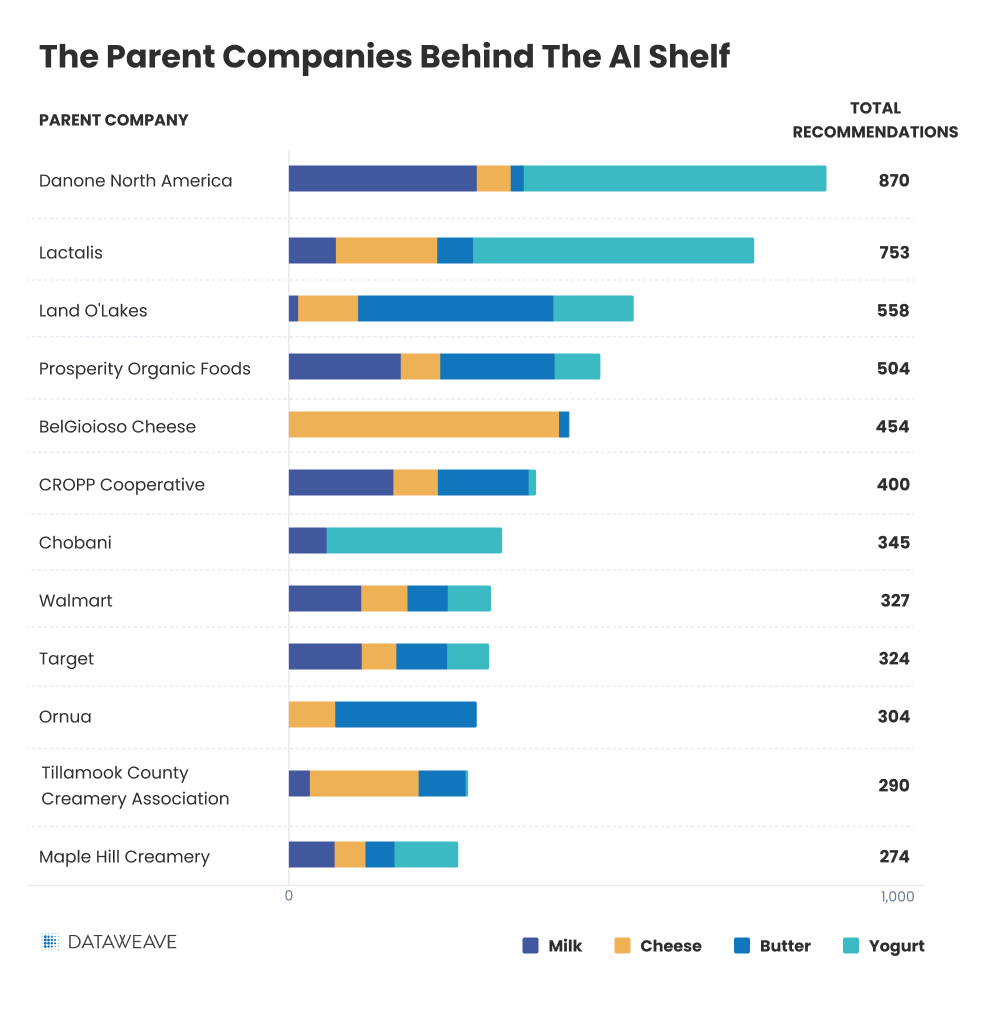
- Three private labels rank in the top seven brands: Together, Kirkland Signature, Good & Gather, and Great Value nearly match the top two national brands combined.
- Walmart and Target’s private labels total 651 recommendations: Counted as one channel, they would rank second among parent companies.
- Two European companies lead the parent view: Danone (870) and Lactalis (829) outrank every US owner because of how many brands they own.
- Dairy alternatives take 21.3% of all recommendations: That share rises above one-third in milk and drops to about 11% in cheese. Silk is the only plant-based brand in the top 15.
3. AI Visibility changes from one assistant to another
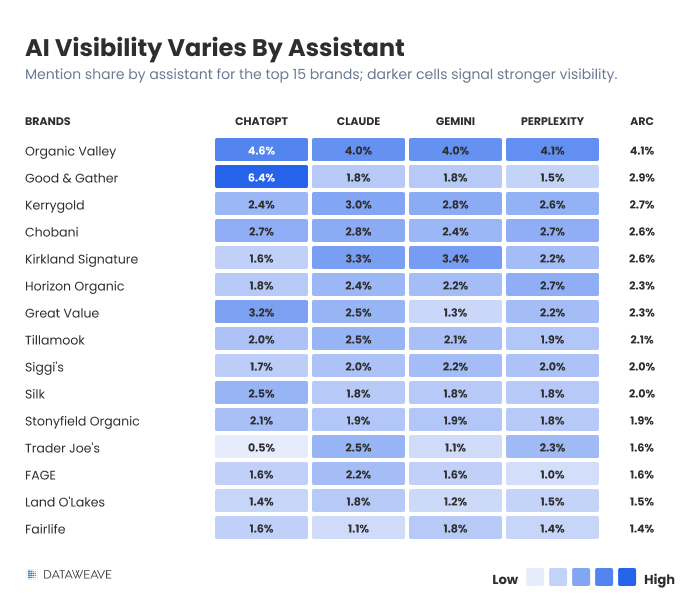
- Organic Valley is the only top-15 brand above 4% on every assistant: Its share stays between 4% and 4.6% across all four.
- Good & Gather has the biggest gap between assistants: It is ChatGPT’s most recommended dairy brand at 6.4%, but gets only 1.5% on Perplexity.
- Trader Joe’s shows the opposite pattern: It gets 0.5% of ChatGPT recommendations and 2.5% on Claude.
- Kirkland Signature does best on Gemini: It reaches 3.4% there, compared with 1.6% on ChatGPT.
4. Cited sources differ by AI assistant
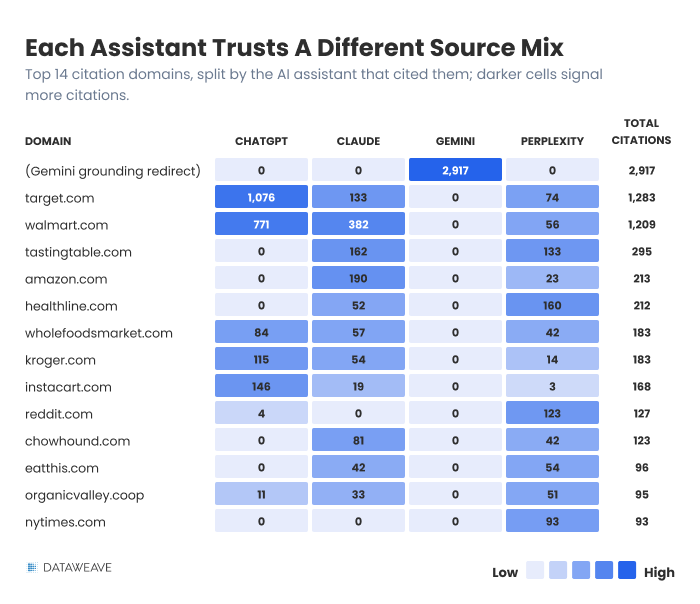
- Retailer product pages are the largest source category: Target, Walmart, Amazon, Kroger, Whole Foods, and Instacart account for 3,239 citations.
- ChatGPT relies on retailers the most: Target and Walmart alone make up 1,847 of its citations.
- Perplexity favors editorial and health publishers like Healthline, The New York Times, and Tasting Table. Claude uses a mix of retailer and editorial sites.
- Gemini’s sources are hard to trace: All 2,917 of its citations route through Google grounding redirects. That’s about 24% of all citations in the study.
- Brand-owned sites barely show up: organicvalley.coop is the only brand domain in the top 14, with 95 citations. Reddit has 127.
See the full AI dairy shelf
These findings come from one set of US prompts run in August 2026. AI answers can change with the prompt, model, and time of testing, so it’s essential for brands to have granular data on their ARC on an ongoing basis.
Our interactive dashboard goes much deeper than what’s shared in this article, covering category rankings, parent companies, retailer sources, and demand spaces.
Explore the AI Shelf: US Dairy dashboard.
Want to know where your brands stand? Talk to our team.

Login
For accounts configured with Google ID, use Google login on top.
For accounts using SSO Services, use the button marked "Single Sign-on".